Quicksort is a popular sorting algorithm that chooses a pivot element and sorts the input list around that pivot element. To learn more about quick sort, please click here.
Randomized quick sort is designed to decrease the chances of the algorithm being executed in the worst case time complexity of O(n2). The worst case time complexity of quick sort arises when the input given is an already sorted list, leading to n(n 1) comparisons. There are two ways to randomize the quicksort −
- Randomly shuffling the inputs: Randomization is done on the input list so that the sorted input is jumbled again which reduces the time complexity. However, this is not usually performed in the randomized quick sort.
- Randomly choosing the pivot element: Making the pivot element a random variable is commonly used method in the randomized quick sort. Here, even if the input is sorted, the pivot is chosen randomly so the worst case time complexity is avoided.
Randomized Quick Sort Algorithm
The algorithm exactly follows the standard algorithm except it randomizes the pivot selection.
Pseudocode
partition-left(arr[], low, high)
   pivot = arr[high]
   i = low // place for swapping
   for j := low to high  1 do
      if arr[j] <= pivot then
         swap arr[i] with arr[j]
         i = i + 1
   swap arr[i] with arr[high]
   return i

partition-right(arr[], low, high)
   r = Random Number from low to high
   Swap arr[r] and arr[high]
   return partition-left(arr, low, high)

quicksort(arr[], low, high)
   if low < high
      p = partition-right(arr, low, high)
      quicksort(arr, low , p-1)
      quicksort(arr, p+1, high)
Example
Let us look at an example to understand how randomized quicksort works in avoiding the worst case time complexity. Since, we are designing randomized algorithms to decrease the occurrence of worst cases in time complexity lets take a sorted list as an input for this example.
The sorted input list is 3, 5, 7, 8, 12, 15. We need to apply the quick sort algorithm to sort the list.

Step 1
Considering the worst case possible, if the random pivot chosen is also the highest index number, it compares all the other numbers and another pivot is selected.
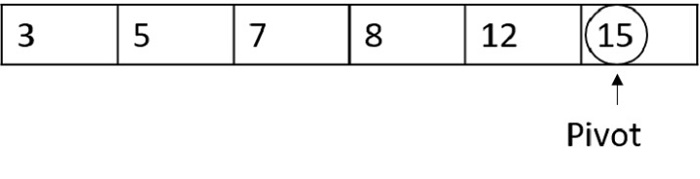
Since 15 is greater than all the other numbers in the list, it wont be swapped, and another pivot is chosen.
Step 2
This time, if the random pivot function chooses 7 as the pivot number −
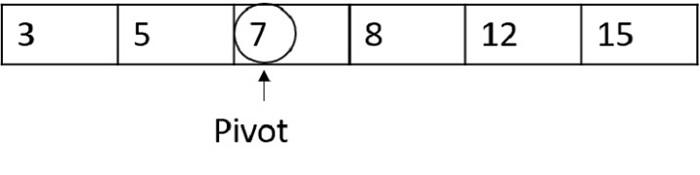
Now the pivot divides the list into half so standard quick sort is carried out usually. However, the time complexity is decreased than the worst case.
It is to be noted that the worst case time complexity of the quick sort will always remain O(n2) but with randomizations we are decreasing the occurrences of that worst case.
Implementation
Following are the implementations of the above approach in various programming langauges −
#include <stdio.h>#include <stdlib.h>#include <time.h>// Function to swap two elementsvoidswap(int* a,int* b){int t =*a;*a =*b;*b = t;}// Function to partition the arrayintpartition_left(int arr[],int low,int high){int pivot = arr[high];int i = low;for(int j = low; j < high; j++){if(arr[j]<= pivot){swap(&arr[i],&arr[j]);
            i++;}}swap(&arr[i],&arr[high]);return i;}// Function to perform random partitionintpartition_right(int arr[],int low,int high){srand(time(NULL));int r = low +rand()%(high - low);swap(&arr[r],&arr[high]);returnpartition_left(arr, low, high);}// Recursive function for quicksortvoidquicksort(int arr[],int low,int high){if(low < high){int p =partition_right(arr, low, high);quicksort(arr, low, p -1);quicksort(arr, p +1, high);}}// Function to print the arrayvoidprintArray(int arr[],int size){for(int i =0; i < size; i++)printf("%d ", arr[i]);printf("\n");}// Driver codeintmain(){int arr[]={6,4,12,8,15,16};int n =sizeof(arr)/sizeof(arr[0]);printf("Original array: ");printArray(arr, n);quicksort(arr,0, n -1);printf("Sorted array: ");printArray(arr, n);return0;}
Output
Original array: 6 4 12 8 15 16
Sorted array: 4 6 8 12 15 16
Leave a Reply