Python is an object-oriented programming language that allows you to create classes and objects. Encapsulation is one of the core principles of OPPs. To achieve encapsulation, we use private variables and methods. In this chapter, we will discuss private variables in Python and how to use them.
Following topics will be covered in this chapter −
- What are Private Variables?
- Defining Private Variables in Python
- Name Mangling for Private Variables
- Private Methods in Python
- Real World Example of Private Variables
- Public vs Protected vs Private Variables
What are Private Variables?
Private variables are a special type of variable that is only accessible within the class they are defined in. Means, they are not directly accessible from outside the class or from any subclass. This is done to protect the data and ensure that it is not modified or accessed by unauthorized code snippets.
Only direct access is restricted. We can define a public method to access the private variable from outside the class, it is called a getter method. Similarly, we can use a setter method to modify the value of a private variable from outside the class.
The image shows how Private variables are different from Public and Protected variables.
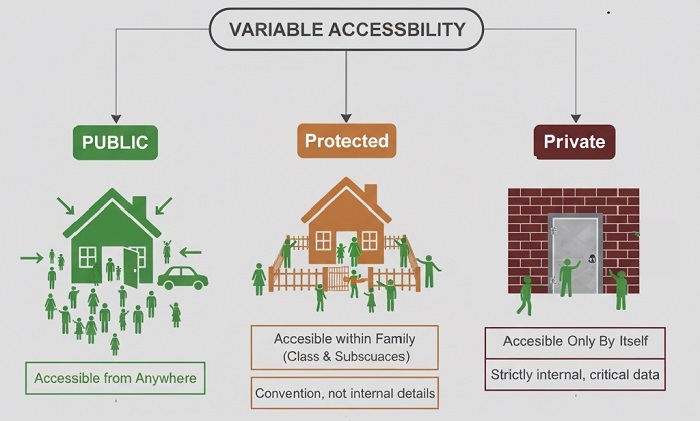
- Public Variables: Public variables are accessible from anywhere, both inside and outside the class. In the image, a public place is considered as an analogy for public variables as they can be accessed by anyone.
- Protected Variables: Protected variable can be accessed within the class and its subclasses. In the image, a private domicile is considered as an analogy for protected variables as they can be accessed by family members (subclasses) but not by outsiders.
- Private Variables: Private variables are only accessible within the class they are defined in. In the image, a vault is considered as an analogy for private variables as they can only be accessed by the owner (the class itself) and not by anyone else.
Defining Private Variables in Python
In Python, private variables are defined by adding a double underscore (__) before the variable name. Unlike other programming languages like Java or C++, Python does not have strict access modifiers like public, private, or protected. So, the double underscore is a convention used to indicate that a variable is private. Similarly, a single underscore (_) is used to indicate that a variable is protected.
Example
The code below shows how to define a private variable and access it using a public method.
classMyClass:def__init__(self):
        self.__private_var ="I am Private"defshow_private(self):return self.__private_var

obj = MyClass()# print(obj.__private_var)   # ✗ AttributeErrorprint(obj.show_private())# ✓ Access through method
We have commented out the direct access to the private variable (Uncommenting it will raise an AttributeError). So, the output of the above code will be −
I am Private
Name Mangling for Private Variables
In Python, private variables are not truly private. They can still be accessed from outside the class using a technique called name mangling. That is, when you create a private variable using a double underscore (__var), Python internally changes its name to _ClassName__var. Now, you can access the private variable using this mangled name. Let’s see an example to understand this better.
classMyClass:def__init__(self):
        self.__private_var ="I am Private"defshow_private(self):return self.__private_var

obj = MyClass()# Accessing private variable using name manglingprint(obj._MyClass__private_var)# ✓ Access using name mangling
The output of the above code will be −
I am Private
Private Methods in Python
Similar to private variables, we can also define private methods in Python. Private methods are methods that are only accessible within the class they are defined in. They are not accessible from outside the class or from any subclass. To define a private method, we use a double underscore (__) before the method name.
classMyClass:def__init__(self):
        self.__private_var ="I am Private"def__private_method(self):return"This is a private method"defshow_private(self):return self.__private_var +" and "+ self.__private_method()

obj = MyClass()print(obj.show_private())# ✓ Access through method# print(obj.__private_method())  # ✗ AttributeErrorprint(obj._MyClass__private_method())# ✓ Access using name mangling
The output of the above code will be −
I am Private and This is a private method
This is a private method
Real World Example of Private Variables
Consider a banking application where we have a class called BankAccount. This class has private variables for the account number and balance. We will define public methods to deposit, withdraw, and check the balance. We need to ensure that balance cannot be directly modified outside the class, but can only be changed through deposit and withdraw methods.
The code below demonstrates this concept.
classBankAccount:def__init__(self, account_number, balance):
        self.__account_number = account_number   # Private
        self.__balance = balance                 # Privatedefdeposit(self, amount):if amount >0:
            self.__balance += amount
        return self.__balance

    defwithdraw(self, amount):if0< amount <= self.__balance:
            self.__balance -= amount
        return self.__balance

    defget_balance(self):return self.__balance

account = BankAccount("12345",1000)# Direct access will failtry:
    account.__balance +=500# ✗ AttributeErrorexcept AttributeError:print("Direct access to private variable failed!!!")# Access using methodsprint("Your account balance is: ", account.get_balance())# ✓ 1000

account.deposit(500)print("Your account balance after deposit is: ", account.get_balance())# ✓ 1500
The output of the above code will be −
Direct access to private variable failed!!!
Your account balance is:  1000
Your account balance after deposit is:  1500
Public vs Protected vs Private Variables
Here is a tabular comparison of Public, Protected, and Private variables in Python −
| Feature | Public Variables | Protected Variables | Private Variables |
|---|---|---|---|
| Definition | Variables that can be accessed from anywhere. | Variables that can be accessed within the class and its subclasses. | Variables that can only be accessed within the class they are defined in. |
| Syntax | int var | int _var | int __var |
| Security | Least secure | Moderately secure | Most secure |
| Example | int age = 25 | int _age = 25 | int __age = 25 |
Conclusion
In this chapter, we learned about private variables in Python and how to use them to achieve encapsulation. We also discussed name mangling, how private methods work, getters and setters. The name mangling technique allows us to access private variables and methods from outside the class, but it is not recommended to use it as it breaks the encapsulation principle.
Leave a Reply