Blog

  • ML – Mathematics

    Machine learning is an interdisciplinary field that involves computer science, statistics, and mathematics. In particular, mathematics plays a critical role in developing and understanding machine learning algorithms. In this chapter, we will discuss the mathematical concepts that are essential for machine learning, including linear algebra, calculus, probability, and statistics.

    Linear Algebra

    Linear algebra is the branch of mathematics that deals with linear equations and their representation in vector spaces. In machine learning, linear algebra is used to represent and manipulate data. In particular, vectors and matrices are used to represent and manipulate data points, features, and weights in machine learning models.

    A vector is an ordered list of numbers, while a matrix is a rectangular array of numbers. For example, a vector can represent a single data point, and a matrix can represent a dataset. Linear algebra operations, such as matrix multiplication and inversion, can be used to transform and analyze data.

    Followings are some of the important linear algebra concepts highlighting their importance in machine learning −

    • Vectors and matrix − Vectors and matrices are used to represent datasets, features, target values, weights, etc.
    • Matrix operations − operations such as addition, multiplication, subtraction, and transpose are used in all ML algorithms.
    • Eigenvalues and eigenvectors − These are very useful in dimensionality reduction related algorithms such principal component analysis (PCA).
    • Projection − Concept of hyperplane and projection onto a plane is essential to understand support vector machine (SVM).
    • Factorization − Matrix factorization and singular value decomposition (SVD) are used to extract important information in the dataset.
    • Tensors − Tensors are used in deep learning to represent multidimensional data. A tensor can represent a scalar, vector or matrix.
    • Gradients − Gradients are used to find optimal values of the model parameters.
    • Jacobian Matrix − Jacobian matrix is used to analyze the relationship between input and output variables in ML model
    • Orthogonality − This is a core concept used in algorithms like principal component analysis (PCA), support vector machines (SVM)

    Calculus

    Calculus is the branch of mathematics that deals with rates of change and accumulation. In machine learning, calculus is used to optimize models by finding the minimum or maximum of a function. In particular, gradient descent, a widely used optimization algorithm, is based on calculus.

    Gradient descent is an iterative optimization algorithm that updates the weights of a model based on the gradient of the loss function. The gradient is the vector of partial derivatives of the loss function with respect to each weight. By iteratively updating the weights in the direction of the negative gradient, gradient descent tries to minimize the loss function.

    Followings are some of the important calculus concepts essential for machine learning −

    • Functions − Functions are core of machine learning. In machine learning, model learns a function between inputs and outputs during the training phase. You should learn basics of functions, continuous and discrete functions.
    • Derivative, Gradient and Slope − These are the core concepts to understand how optimization algorithms, like gradient descent, work.
    • Partial Derivatives − These are used to find maxima or minima of a function. Generally used in optimization algorithms.
    • Chain Rules − Chain rules are used to calculate the derivatives of loss functions with multiple variables. You can see the application of chain rules mainly in neural networks.
    • Optimization Methods − These methods are used to find the optimal values of parameters that minimizes cost function. Gradient Descent is one of the most used optimization methods.

    Probability Theory

    Probability is the branch of mathematics that deals with uncertainty and randomness. In machine learning, probability is used to model and analyze data that are uncertain or variable. In particular, probability distributions, such as Gaussian and Poisson distributions, are used to model the probability of data points or events.

    Bayesian inference, a probabilistic modeling technique, is also widely used in machine learning. Bayesian inference is based on Bayes’ theorem, which states that the probability of a hypothesis given the data is proportional to the probability of the data given the hypothesis multiplied by the prior probability of the hypothesis. By updating the prior probability based on the observed data, Bayesian inference can make probabilistic predictions or classifications.

    Followings are some of the important probability theory concepts essential for machine learning −

    • Simple probability − It’s a fundamental concept in machine learning. All classification problems use probability concepts. SoftMax function uses simple probability in artificial neural networks.
    • Conditional probability − Classification algorithms like the Naive Bayes classifier are based on conditional probability.
    • Random Variables − Random variables are used to assign the initial values to the model parameters. Parameter initialization is considered as the starting of the training process.
    • Probability distribution − These are used in finding loss functions for classification problems.
    • Continuous and Discrete distribution − These distributions are used to model different types of data in ML.
    • Distribution functions − These functions are often used to model the distribution of error terms in linear regression and other statistical models.
    • Maximum likelihood estimation − It is a base of some machine learning and deep learning approaches used for classification problems.

    Statistics

    Statistics is the branch of mathematics that deals with the collection, analysis, interpretation, and presentation of data. In machine learning, statistics is used to evaluate and compare models, estimate model parameters, and test hypotheses.

    For example, cross-validation is a statistical technique that is used to evaluate the performance of a model on new, unseen data. In cross-validation, the dataset is split into multiple subsets, and the model is trained and evaluated on each subset. This allows us to estimate the model’s performance on new data and compare different models.

    Followings are some of the important statistics concepts essential for machine learning −

    • Mean, Median, Mode − These measures are used to understand the distribution of data and identify outliers.
    • Standard deviation, Variance − These are used to understand the variability of a dataset and to detect outliers.
    • Percentiles − These are used to summarize the distribution of a dataset and identify outliers.
    • Data Distribution − It is how data points are distributed or spread out across a dataset.
    • Skewness and Kurtosis − These are two important measures of the shape of a probability distribution in machine learning.
    • Bias and Variance − They describe the sources of error in a model’s predictions.
    • Hypothesis Testing − It is a tentative assumption or idea that can be tested and validated using data.
    • Linear Regression − It is the most used regression algorithm in supervised machine learning.
    • Logistic Regression − It’s also an important supervised learning algorithm mostly used in machine learning.
    • Principal Component Analysis − It is used mainly in dimensionality reduction in machine learning.
  • ML – Data Structure

    Data structure plays a critical role in machine learning as it facilitates the organization, manipulation, and analysis of data. Data is the foundation of machine learning models, and the data structure used can significantly impact the model’s performance and accuracy.

    Data structures help to build and understand various complex problems in Machine learning. A careful choice of data structures can help to enhance the performance and optimize the machine learning models.

    What is Data Structure?

    Data structures are ways of organizing and storing data to use it efficiently. They include structures like arrays, linked lists, stacks, and others, which are designed to support specific operations. They play a crucial role in machine learning, especially in tasks such as data preprocessing, algorithm implementation, and optimization.

    Here we will discuss some commonly used data structures and how they are used in Machine Learning.

    Commonly Used Data Structure for Machine Learning

    Data structure is an essential component of machine learning, and the right data structure can help in achieving faster processing, easier access to data, and more efficient storage. Here are some commonly used data structures for machine learning −

    1. Arrays

    Array is a fundamental data structure used for storing and manipulating data in machine learning. Array elements can be accessed using the indexes. They allow fast data retrieval as the data is stored in contiguous memory locations and can be accessed easily.

    As we can perform vectorized operations on arrays, it is a good choice to represent the input data as arrays.

    Some machine learning tasks that use arrays are:

    • The raw data is usually represented in the form of arrays.
    • To convert pandas data frame into list, because pandas series require all the elements to be the same type, which Python list contains combination of data types.
    • Used for data preprocessing techniques like normalization, scaling and reshaping.
    • Used in word embedding, while creating multi-dimensional matrices.

    Arrays are easy to use and offer fast indexing, but their size is fixed, which can be a limitation when working with large datasets.

    2. Lists

    Lists are collections of heterogeneous data types that can be accessed using an iterator. They are commonly used in machine learning for storing complex data structures, such as nested lists, dictionaries, and tuples. Lists offer flexibility and can handle varying data sizes, but they are slower than arrays due to the need for iteration.

    3. Dictionaries

    Dictionaries are a collection of key-value pairs that can be accessed using the keys. They are commonly used in machine learning for storing metadata or labels associated with data. Dictionaries offer fast access to data and are useful for creating lookup tables, but they can be memory-intensive when dealing with large datasets.

    4. Linked Lists

    Linked lists are collections of nodes, each containing a data element and a reference to the next node in the list. They are commonly used in machine learning for storing and manipulating sequential data, such as time-series data. Linked lists offer efficient insertion and deletion operations, but they are slower than arrays and lists when it comes to accessing data.

    Linked lists are commonly used for managing dynamic data where elements are frequently added and removed. They are less common compared to arrays, which are more efficient for the data retrieval process.

    5. Stack and Queue

    Stack is based on the LIFO(Last In First Out). Stacking classifier approach can efficiently be implemented in solving multi-classification problems by dividing it into several binary classification problems. This is done by stacking all the outputs from binary classification and passing it as input to the meta classifier.

    Queue follows FIFO(First In First Out) structure which is similar to people waiting in a line. This data structure is used in Multi threading, which is used to optimize and coordinate data flow between threads in multi threaded environment. It is usually used to handle large amounts of data, to feed batches of data for the training process. To make sure that the training process is continuous and efficient.

    6. Trees

    Trees are hierarchical data structures that are commonly used in machine learning for decision-making algorithms, such as decision trees and random forests. Trees offer efficient searching and sorting algorithms, but they can be complex to implement and can suffer from overfitting.

    Binary trees are hierarchical data structures that are commonly used in machine learning for decision-making algorithms, such as decision trees and random forests. Trees offer efficient searching and sorting algorithms, but they can be complex to implement and can suffer from overfitting.

    7. Graphs

    Graphs are collections of nodes and edges that are commonly used in machine learning for representing complex relationships between data points. Data structures such as adjacency matrices and linked lists are used to create and manipulate graphs. Graphs offer powerful algorithms for clustering, classification, and prediction, but they can be complex to implement and can suffer from scalability issues.

    Graphs are widely used in recommendation systemlink prediction, and social media analysis.

    8. Hash Maps

    Hash maps are predominantly used in machine learning due to its key-value storage and retrieval capabilities. They are commonly used in machine learning for storing metadata or labels associated with data. Dictionaries offer fast access to data and are useful for creating lookup tables, but they can be memory-intensive when dealing with large datasets.

    In addition to the above-mentioned data structures, many machine learning libraries and frameworks provide specialized data structures for specific use cases, such as matrices and tensors for deep learning. It is important to choose the right data structure for the task at hand, considering factors such as data size, processing speed, and memory usage.

    How Data Structure is Used in Machine Learning?

    Below are some ways data structures are used in machine learning −

    Storing and Accessing Data

    Machine learning algorithms require large amounts of data for training and testing. Data structures such as arrays, lists, and dictionaries are used to store and access data efficiently. For example, an array can be used to store a set of numerical values, while a dictionary can be used to store metadata or labels associated with data.

    Pre-processing Data

    Before training a machine learning model, it is necessary to pre-process the data to clean, transform, and normalize it. Data structures such as lists and arrays can be used to store and manipulate the data during pre-processing. For example, a list can be used to filter out missing values, while an array can be used to normalize the data.

    Creating Feature Vectors

    Feature vectors are a critical component of machine learning models as they represent the features that are used to make predictions. Data structures such as arrays and matrices are commonly used to create feature vectors. For example, an array can be used to store the pixel values of an image, while a matrix can be used to store the frequency distribution of words in a text document.

    Building Decision Trees

    Decision trees are a common machine learning algorithm that uses a tree data structure to make decisions based on a set of input features. Decision trees are useful for classification and regression problems. They are created by recursively splitting the data based on the most informative features. The tree data structure makes it easy to traverse the decision-making process and make predictions.

    Building Graphs

    Graphs are used in machine learning to represent complex relationships between data points. Data structures such as adjacency matrices and linked lists are used to create and manipulate graphs. Graphs are used for clustering, classification, and prediction tasks.

  • ML – Real-Life Examples

    Machine learning has transformed various industries by automating processes, predicting outcomes, and discovering patterns in large data sets. Some real-life examples of machine learning include virtual assistants & chatbots such as Google Assistant, Siri & Alexa, recommendation systems, Tesla autopilot, IBM’s Watson for Oncology, etc.

    Most of us think that machine learning is something that is related to technology about futuristic robots that is very complex. Surprisingly, every one of us uses machine learning in our daily lives knowingly or unknowingly, such as Google Maps, email, Alexa, etc. Here we are providing the top real-life examples of machine learning −

    • Virtual Assistants and Chatbots
    • Fraud Detection in Banking and Finance
    • Healthcare Diagnosis and Treatment
    • Autonomous Vehicles
    • Recommendation Systems
    • Target Advertising
    • Image Recognition

    Let’s discuss each of the above real-life examples of machine learning in detail −

    Virtual Assistants and Chatbots

    Natural language processing (NLP) is an area of machine learning that focuses on understanding and generating human language. NLP is used in virtual assistants and chatbots, such as Siri, Alexa, and Google Assistant, to provide personalized and conversational experiences. Machine learning algorithms can analyze language patterns and respond to user queries in a natural and accurate way.

    Virtual assistants are applications of machine learning that interact with users through voice instructions. They are used to replace the work performed by human personal assistants, which includes making phone calls, scheduling appointments, or reading an email loud. The most popular virtual assistants that are used in our daily lives are Alexa, Apple Siri, and Google Assistant .

    Chatbots are machine learning programs designed to engage in conversations with users. This application is designed to replace the work of customer care. It is widely used by websites for providing information, answering FAQ, and providing basic customer support.

    Fraud Detection in Banking and Finance

    Machine learning is not only applied to make things easier but is also applied for safety and security purposes, like fraud detection. These algorithms are trained on datasets with undesired or fraud activities to identify similar patterns of these events and detect them when they occur in the future.

    These algorithms can analyze transaction data and identify patterns that indicate fraud. For example, credit card companies use machine learning to identify transactions that are likely to be fraudulent and notify customers in real time. Banks also use machine learning to detect money laundering, identify unusual behavior in accounts, and analyze credit risk.

    Machine learning algorithms are widely used in the financial industry to detect fraudulent activities. One real-life example can include PayPal which uses machine learning to improve authorized transactions on its platform.

    Healthcare Diagnosis and Treatment

    The applications of machine learning in health care are as diverse as they impact. The combination of machine learning and medicine aims to enhance the efficiency and personalization of healthcare. Some of them include personalized treatment, patient monitoring, and medical imaging diagnosis.

    Machine learning algorithms can analyze medical data, such as X-rays, MRI scans, and genomic data, to assist with the diagnosis of diseases. These algorithms can also be used to identify the most effective treatment for a patient based on their medical history and genetic makeup. For example, IBM’s Watson for Oncology uses machine learning to analyze medical records and recommend personalized cancer treatments.

    Autonomous Vehicles

    Autonomous vehicles use machine learning to partially replace human drivers. These vehicles are designed to reach the destination avoiding obstacles and responding to traffic conditions. Autonomous vehicles use machine learning algorithms to navigate and make decisions on the road. These algorithms can analyze data from sensors and cameras to identify obstacles and make decisions about how to respond.

    Autonomous vehicles are expected to revolutionize transportation by reducing accidents and increasing efficiency. Companies such as Tesla, Waymo, and Uber are using machine learning to develop self-driving cars.

    Tesla’s self-driving cars are installed with Tesla Vision, which uses cameras, sensors, and powerful neural net processing to sense and understand the environment around them. One of the real-life examples of machine learning in autonomous vehicles is Tesla AutoPilot. AutoPilot is an advanced driver assistance system.

    Recommendation Systems

    E-commerce platforms, such as Amazon and Netflix, use recommendation systems (machine learning algorithms) to provide personalized recommendations to users based on their browsing and viewing history. These recommendations can improve customer satisfaction and increase sales. Machine learning algorithms can analyze large amounts of data to identify patterns and predict user preferences, enabling e-commerce platforms and entertainment providers to offer a more personalized experience to their users.

    This application of Machine learning is used to narrow down and predict what people are looking for among the growing number of options. Some popular real-world examples of recommendation systems are as follows −

    • Netflix − Netflix’s recommendation system uses machine learning algorithms to analyze user’s watch history, search behavior, and rating to suggest movies and TV shows.
    • Amazon − Amazon’s recommendation system makes personalized recommendations based on user’s prior products viewed, purchases, and items added to their carts.
    • Spotify − Spotify’s recommendation system suggests songs and playlists depending on the user’s listening history, search, and liked songs, etc.
    • YouTube − YouTube’s recommendation system suggests videos based on the user’s viewing history, search, liked video, etc. The machine learning algorithm considers many other factors to make personalized recommendations.
    • LinkedIn − LinkedIn’s recommendation system suggests jobs, connections, etc., based on the user’s profile, skills, etc. The machine learning algorithms take the user’s current job profile, skills, location, industry, etc., to make personalized job recommendations.

    Target Advertising

    Targeted advertising uses machine learning to gain insights from data-driven to tailor advertisements based on the interests, behavior, and demographics of the individuals or groups.

    Image Recognition

    Image recognition is an application of computer vision that requires more than one computer vision task, such as image classification, object detection and image identification. It is prominently used in facial recognition, visual search, medical diagnosis, people identification and many more.

    In addition to these examples, machine learning is being used in many other applications, such as energy management, social media analysis, and predictive maintenance. Machine learning is a powerful tool that has the potential to revolutionize many industries and improve the lives of people around the world.

  • ML – Limitations

    Machine learning is a powerful technology that has transformed the way we approach data analysis, but like any technology, it has its limitations. Here are some of the key limitations of machine learning −

    Dependence on Data Quality

    Machine learning models are only as good as the data used to train them. If the data is incomplete, biased, or of poor quality, the model may not perform well.

    Lack of Transparency

    Machine learning models can be very complex, making it difficult to understand how they arrive at their predictions. This lack of transparency can make it challenging to explain model results to stakeholders.

    Limited Applicability

    Machine learning models are designed to find patterns in data, which means they may not be suitable for all types of data or problems.

    High Computational Costs

    Machine learning models can be computationally expensive, requiring significant processing power and storage.

    Data Privacy Concerns

    Machine learning models can sometimes collect and use personal data, which raises concerns about privacy and data security.

    Ethical Considerations

    Machine learning models can sometimes perpetuate biases or discriminate against certain groups, raising ethical concerns.

    Dependence on Experts

    Developing and deploying machine learning models requires significant expertise in data science, statistics, and programming, making it challenging for organizations without access to these skills.

    Lack of Creativity and Intuition

    Machine learning algorithms are good at finding patterns in data but lack creativity and intuition. This means that they may not be able to solve problems that require creative thinking or intuition.

    Limited Interpretability

    Some machine learning models, such as deep neural networks, can be difficult to interpret. This means that it may be challenging to understand how the model arrived at its predictions.

  • ML – Challenges & Common Issues

    Machine learning is a rapidly growing field with many promising applications. However, there are also several challenges and issues that must be addressed to fully realize the potential of machine learning. Some of the major challenges and common issues faced in machine learning include −

    Overfitting

    Overfitting occurs when a model is trained on a limited set of data and becomes too complex, leading to poor performance when tested on new data. This can be addressed by using techniques such as cross-validation, regularization, and early stopping.

    Underfitting

    Underfitting occurs when a model is too simple and fails to capture the patterns in the data. This can be addressed by using more complex models or by adding more features to the data.

    Data Quality Issues

    Machine learning models are only as good as the data they are trained on. Poor quality data can lead to inaccurate models. Data quality issues include missing values, incorrect values, and outliers.

    Imbalanced Datasets

    Imbalanced datasets occur when one class of data is significantly more prevalent than another. This can lead to biased models that are accurate for the majority class but perform poorly on the minority class.

    Model Interpretability

    Machine learning models can be very complex, making it difficult to understand how they arrive at their predictions. This can be a challenge when explaining the model to stakeholders or regulatory bodies. Techniques such as feature importance and partial dependence plots can help improve model interpretability.

    Generalization

    Machine learning models are trained on a specific dataset, and they may not perform well on new data that is outside the training set. This can be addressed by using techniques such as cross-validation and regularization.

    Scalability

    Machine learning models can be computationally expensive and may not scale well to large datasets. Techniques such as distributed computing, parallel processing, and sampling can help address scalability issues.

    Ethical Considerations

    Machine learning models can raise ethical concerns when they are used to make decisions that affect people’s lives. These concerns include bias, privacy, and transparency. Techniques such as fairness metrics and explainable AI can help address ethical considerations.

    Addressing these issues requires a combination of technical expertise and business knowledge, as well as an understanding of ethical considerations. By addressing these issues, machine learning can be used to develop accurate and reliable models that can provide valuable insights and drive business value.

  • ML – Implementation

    Implementing machine learning involves several steps, which include −

    Data Collection and Preparation

    The first step in implementing machine learning is collecting the data that will be used to train and test the model. The data should be relevant to the problem that the machine learning model is being built to solve. Once the data has been collected, it needs to be preprocessed and cleaned to remove any inconsistencies or missing values.

    Data Exploration and Visualization

    The next step is to explore and visualize the data to gain insights into its structure and identify any patterns or trends. Data visualization tools such as matplotlib and seaborn can be used to create visualizations such as histograms, scatter plots, and heat maps.

    Feature Selection and Engineering

    The features of the data that are relevant to the problem need to be selected or engineered. Feature engineering involves creating new features from existing data that can improve the accuracy of the model.

    Model Selection and Training

    Once the data has been prepared and features selected or engineered, the next step is to select a suitable machine learning algorithm to train the model. This involves splitting the data into training and testing sets and using the training set to fit the model. Various machine learning algorithms such as linear regression, logistic regression, decision trees, random forests, support vector machines, and neural networks can be used to train the model.

    Model Evaluation

    After training the model, it needs to be evaluated to determine its performance. The performance of the model can be evaluated using metrics such as accuracy, precision, recall, and F1 score. Cross-validation techniques can also be used to test the model’s performance.

    Model Tuning

    The performance of the model can be improved by tuning its hyperparameters. Hyperparameters are settings that are not learned from the data, but rather set by the user. The optimal values for these hyperparameters can be found using techniques such as grid search and random search.

    Deployment and Monitoring

    Once the model has been trained and tuned, it needs to be deployed to a production environment. The deployment process involves integrating the model into the business process or system. The model also needs to be monitored regularly to ensure that it continues to perform well and to identify any issues that need to be addressed.

    Each of the above steps requires different tools and techniques, and successful implementation requires a combination of technical and business skills.

    Choosing the Language and IDE for ML Development

    To develop ML applications, you will have to decide on the platform, the IDE and the language for development. There are several choices available. Most of these would meet your requirements easily as all of them provide the implementation of AI algorithms discussed so far.

    If you are developing the ML algorithm on your own, the following aspects need to be understood carefully −

    The language of your choice − this essentially is your proficiency in one of the languages supported in ML development.

    The IDE that you use − This would depend on your familiarity with the existing IDEs and your comfort level.

    Development platform − There are several platforms available for development and deployment. Most of these are free-to-use. In some cases, you may have to incur a license fee beyond a certain amount of usage. Here is a brief list of choice of languages, IDEs and platforms for your ready reference.

    Language Choice

    Here is a list of languages that support ML development −

    • Python
    • R
    • Matlab
    • Octave
    • Julia
    • C++
    • C

    This list is not essentially comprehensive; however, it covers many popular languages used in machine learning development. Depending upon your comfort level, select a language for the development, develop your models and test.

    IDEs

    Here is a list of IDEs which support ML development −

    • R Studio
    • Pycharm
    • iPython/Jupyter Notebook
    • Julia
    • Spyder
    • Anaconda
    • Rodeo
    • Google Colab

    The above list is not essentially comprehensive. Each one has its own merits and demerits. The reader is encouraged to try out these different IDEs before narrowing down to a single one.

  • ML – Required Skills

    Machine learning is a rapidly growing field that requires a combination of technical and soft skills to be successful. Machine learning is expanding its applications into different sectors, and choosing to become an expert in machine learning would be a wise career move. So make sure to learn all the skills that would help you improve your capabilities in pursuing machine learning as a career.

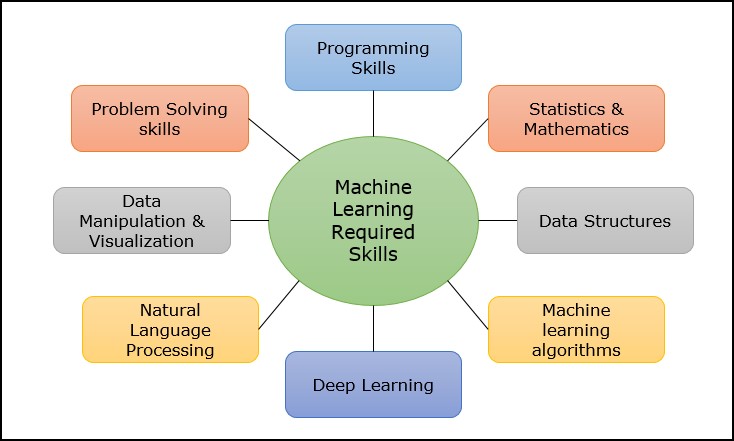
    Here are some of the key skills required for machine learning −

    • Programming Skills
    • Statistics and Mathematics
    • Data Structures
    • Data Preprocessing
    • Data Visualization
    • Machine Learning Algorithms
    • Neural Networks & Deep Learning
    • Natural Language Processing
    • Problem-solving Skills
    • Communication Skills
    • Business Acumen

    The following image depicts some important skills required for machine learning −

    ML Required Skills

    Let us discuss each of the above skills required for machine learning in detail −

    Programming Skills

    Machine learning requires a solid foundation in programming skills, particularly in languages such as Python, R, and Java. Proficiency in programming allows data scientists to build, test, and deploy machine learning models.

    Python is the most popular programming language due to its increased adoption of machine learning algorithms in recent years. It is ideal as it offers various libraries and packages like NumPy, Matplotlib, Sklearn, Seaborn, Keras, TensorFlow, etc., that ease the processes in machine learning. Following are some basics of Python that would help you understand machine learning algorithms −

    • Basic data types, Dictionaries, Lists, Sets
    • Loops and Conditional statements
    • Functions
    • List comprehensions

    R programming is another popular programming language in the field of machine learning. It might not be as popular as Python, but it makes heavy machine learning tasks easier. Along with learning the fundamentals of the programming language, one should also gain knowledge of the packages that the programming language offers.

    Statistics and Mathematics

    A strong understanding of statistics and mathematics is essential for machine learning. Data scientists must be able to understand and apply statistical models, algorithms, and methods to analyze and interpret data.

    Statistics is used to make inferences in data and draw conclusions. The formulas in statistics are used to interpret data for data-driven decisions. It is broadly categorized into descriptive and inferential statistics. Descriptive analysis involves simplifying and organizing data using concepts like mean, range, variance and standard deviation. Whereas inferential analysis involves considering smaller data to draw conclusions on large datasets using concepts like hypothesis testing, null & alternative testing, etc.

    A lot of mathematical formulas are used to develop machine learning algorithms and also to set parameters and evaluate performance metrics. Some concepts of mathematics that are good to know are −

    • Algebra − You don’t have to be an expert in all the concepts; you just need to know the basics like variables, constants and functions, linear equations, and logarithms.
    • Linear algebra− It is the study of vectors and linear mapping. Get a firm grip on fundamental concepts like vectors, matrices, and eigenvalues.
    • Calculus− Understand the concepts of derivatives, integrals, and gradient descent, which help to develop advanced models that identify patterns and predict outcomes.

    You might be wondering how mathematics is related to machine learning algorithms. Well, an example of it is that the formula for Linear regression(a type of supervised learning algorithm) is y=ax+b, which is a linear expression in algebra.

    To give you a brief idea of what skills you need to acquire, let us discuss some examples

    Mathematical Notation

    Most of the machine learning algorithms are heavily based on mathematics. The level of mathematics that you need to know is probably just a beginner level. What is important is that you should be able to read the notation that mathematicians use in their equations. For example – if you can read the notation and comprehend what it means, you are ready for learning machine learning. If not, you may need to brush up your mathematics knowledge.

    $$f_{AN}(net-\theta)=\begin{cases}\gamma & if\:net-\theta \geq \epsilon\\net-\theta & if – \epsilon

    maxα[∑i=1mα−12∑i,j=1mlabel(i)⋅label(j)⋅ai⋅aj⟨x(i),x(j)⟩]

    fAN(net−θ)=(eλ(net−θ)−e−λ(net−θ)eλ(net−θ)+e−λ(net−θ))

    Probability Theory

    Probability is another important fundamental pre-requisite since machine learning is all about making machines learn how to predict. Major concepts in probability that one should be familiar with are random variables, probability density or distribution, etc.

    Here is an example to test your current knowledge of probability theory: Classifying with conditional probabilities.

    p(ci|x,y)=p(x,y|ci)p(ci)p(x,y)

    With these definitions, we can define s Bayesian classification rule −

    • If P(c1|x, y) > P(c2|x, y) , the class is c1 .
    • If P(c1|x, y) < P(c2|x, y) , the class is c2 .

    Optimization Problem

    Here is an optimization function,

    maxα[∑i=1mα−12∑i,j=1mlabel(i)⋅label(j)⋅ai⋅aj⟨x(i),x(j)⟩]

    Subject to the following constraints −

    α≥0,and∑i−1mαi⋅label(i)=0

    If you can read and understand the above, you are all set.

    Data Structures

    Gaining good exposure on data structures would help solve real-world problems and build software products. Data structures help to tackle and understand complex problems in machine learning. Some concepts in data structures used in machine learning are arrays, stack, queue, binary trees, maps, etc.

    Data Preprocessing

    Preparing data for machine learning requires knowledge of data cleaning, data transformation, and data normalization. This involves identifying and correcting errors, missing values, and inconsistencies in the data.

    Data Visualization

    Data visualization is the process of creating graphical representations of data to help users understand and interpret complex data sets. Data scientists must be able to create effective visualizations that communicate insights from the data. Some data visualization tools that you have to be familiar with are Tableau, Power BI, and many more.

    In many cases, you will need to understand the various types of visualization plots to understand your data distribution and interpret the results of the algorithm’s output.

    Visualization Plots

    Besides the above theoretical aspects of machine learning, you need good programming skills to code those algorithms.

    Machine Learning Algorithms

    Machine learning requires knowledge of various algorithms, such as regression, decision trees, random forests, k-nearest neighbors, support vector machines, and neural networks. Understanding the strengths and weaknesses of these algorithms is critical for building effective machine learning models. Learning about all the algorithms would help understand where and how to apply algorithms.

    Neural Networks & Deep Learning

    Neural networks are algorithms designed to teach computers to possess the ability to function similarly to the human brain. It consists of interconnected nodes or neurons to learn from data.

    Deep learning is a subfield of machine learning that involves training deep neural networks to analyze complex data sets. Deep learning requires a strong understanding of neural networks, convolutional neural networks, recurrent neural networks, and other related topics.

    Natural Language Processing

    Natural language processing (NLP) is a branch of artificial intelligence focusing on the interaction between computers and humans using natural language. NLP requires knowledge of techniques such as sentiment analysis, text classification, and named entity recognition.

    Problem-solving Skills

    Machine learning requires strong problem-solving skills, including the ability to identify problems, generate hypotheses, and develop solutions. Data scientists must be able to think creatively and logically to develop effective solutions to complex problems.

    Communication Skills

    Communication skills are essential for data scientists, as they must be able to explain complex technical concepts to non-technical stakeholders. Data scientists must be able to communicate the results of their analysis and the implications of their findings in a clear and concise manner.

    Business Acumen

    Machine learning is used to solve business problems, and therefore, understanding the business context and the ability to apply machine learning to business problems is essential.

    Overall, machine learning requires a broad range of skills, including technical, mathematical, and soft skills. To be successful in this field, data scientists must be able to combine these skills to develop effective machine learning models that solve complex business problems.

  • ML – Life Cycle

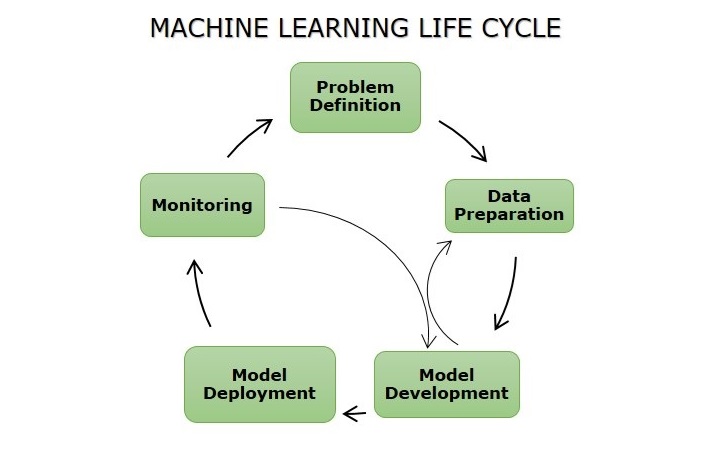
    Machine learning life cycle is an iterative process of building an end to end machine learning project or ML solution. Building a machine learning model is a continuous process especially with the growing amount of data. Machine learning focuses on improving a system’s performance through training the model with real world data. We have to follow some well-defined steps for making a machine learning project successful. The machine learning life cycle provides us with these well-defined steps or phases.

    What is Machine Learning Life Cycle?

    The machine learning life cycle is an iterative process that moves from a business problem to a machine learning solution. It is used as a guide for developing a machine learning project to solve a problem. It provides us with instructions and best practices to be used in each phase while developing ML solutions.

    The machine learning life cycle is a process that involves several phases from problem identification to model deployment and monitoring. While developing an ML project, each step in the life cycle is revisited many times through these phases. The stages/ phases involved in the end to end machine life cycle process are as follows −

    • Problem Definition
    • Data Preparation
    • Model Development
    • Model Deployment
    • Monitoring and Maintenance
    ML Life Cycle

    Let’s discuss the above phases of machine learning life cycle process in detail −

    Problem Definition

    The first step in the machine learning life cycle is to identify the problem you want to solve. It is a crucial step which helps you start building a machine learning solution for a problem. This process of identifying a problem would establish an understanding about what the output might be, scope of the task and its objective.

    As this step lays the foundation for building a machine learning model, the problem definition has to be clear and concise.

    This stage involves understanding the business problem, defining the problem statement, and identifying the success criteria for the machine learning model.

    Data Preparation

    Data preparation is a process to prepare data for analysis by performing data exploration, feature engineering, and feature selection. Data exploration involves visualizing and understanding the data, while feature engineering involves creating new features from the existing data. Feature selection involves selecting the most relevant features that will be used to train the machine learning model.

    Data preparation process includes collecting data, preprocessing data, and feature engineering & feature selection. This stage generally also includes exploratory data analysis.

    Let’s discuss each step involved in the data preparation phase of machine learning life cycle process −

    1. Data Collection

    After the problem statement is analyzed, the next step would be collecting data. This involves gathering data from various sources which is given as a raw material to the machine learning model. Few features that are considered while collecting data are −

    • Relevant and usefulness − The data collected has to be relevant to the problem statement, and also should be useful enough to train the machine learning model efficiently.
    • Quality and Quantity − The quality and quantity of the data collected would directly impact the performance of the machine learning model.
    • Variety − Make sure that the data collected is diverse so that the model can be trained with multiple scenarios to recognize the patterns.

    There are various sources from where the data can be collected like surveys, existing databases, and online platforms like Kaggle. The sources may be primary data which includes data collected exclusively for the problem statement while the secondary data includes the existing data.

    2. Data Preprocessing

    The data collected often might be unstructured and messy which causes it to negatively affect the outcomes, hence pre processing data is important to improve the accuracy and performance of the machine learning model. Issues that have to be addressed are missing values, duplicate data, invalid data and noise.

    This step of data preprocessing also called data wrangling is intended to make the data more consumable and useful for analytics.

    3. Analyzing Data

    After the data is all sorted, it is time to understand the data that is collected. The data is visualized and statistically summarized to gain insights.

    Various tools like Power BI, Tableau are used to visualize data which helps in understanding the patterns and trends in the data. This analysis will help to make choices in feature engineering and model selection.

    4. Feature Engineering and Selection

    A ‘Feature’ is an individual measurable quantity which is preferably observed when the machine learning model is being trained. Feature Engineering is the process of creating new features or enhancing the existing ones to accurately understand the patterns and trends in the data.

    Feature selection involves the process of picking up features that are consistent and more relevant to the problem statement. The process of feature engineering and selection are used to reduce the size of the dataset which is important to tackle the issue of growing data.

    Model Development

    In the model development phase, the machine learning model is built using the prepared data. The model building process involves selecting the appropriate machine learning algorithm, algorithm training, tuning the hyperparameters of the algorithm, and evaluating the performance of the model using cross-validation techniques.

    This phase mainly consists of three steps, model selection, model training, and model evaluation. Let’s discuss these three steps in detail −

    1. Model Selection

    Model selection is a crucial step in the machine learning workflow. The decision of choosing a model depends on basic features like characteristics of the data, complexity of the problem, desired outcomes and how well it aligns with the defined problem. This step affects the outcomes and performance metrics of the model.

    2. Model Training

    In this process, the algorithm is fed with a preprocessed dataset to identify and understand the patterns and relationships in the specified features.

    Consistent training of a model by adjusting parameters would improve the prediction rate and enhance accuracy. This step makes the model reliable in real-world scenarios.

    3. Model Evaluation

    In model evaluation, the performance of the machine learning model is evaluated using a set of evaluation metrics. These metrics measure the accuracy, precision, recall, and F1 score of the model. If the model has not achieved desired performance, the model is tuned to adjust hyper parameters and improve the predictive accuracy. This continuous iteration is essential to make the model more accurate and reliable.

    If the model’s performance is still not satisfactory, it may be necessary to return to the model selection stage and continue to model training and evaluation to improve the model’s performance.

    Model Deployment

    In the model deployment phase, we deploy the machine learning model into production. This process involves integrating the tested model with existing systems to make it available to users, management or other purposes. This also involves testing the model in a real-world scenario.

    Two important factors that have to be checked before deploying are whether the model is portable i.e, the ability to transfer the software from one machine to another and scalable i.e, the model need not be redesigned to maintain performance.

    Monitor and Maintenance

    Monitoring in machine learning involves techniques to measure the model performance metrics and to detect issues in the models. After an issue is detected, the model has to be trained with new data or the architecture has to be modified.

    Sometimes when the issue detected in the designed model cannot be solved with training it with new data, the issue becomes the problem statement. So, the machine learning life cycle revamps from analyzing the problem again to develop an improved model.

    The machine learning life cycle is an iterative process, and it may be necessary to revisit previous stages to improve the model’s performance or address new requirements. By following the machine learning life cycle, data scientists can ensure that their machine learning models are effective, accurate, and meet the business requirements.

  • ML – Applications

    Machine learning has become the ubiquitous technology that has impacted many aspects of our lives, from business to healthcare to entertainment. Machine learning helps make decisions and find all possible solutions to a problem which improves the efficiency of work in every sector.

    Some of the successful machine learning applications are chatbots, language translation, face recognition, recommendation systems, autonomous vehicles, object detection, medical image analysis, etc. Here are some popular applications of machine learning −

    • Image and Speech Recognition
    • Natural Language Processing
    • Finance Sector
    • E-commerce and Retail
    • Automotive Sector
    • Computer Vision
    • Manufacturing and Industries
    • Healthcare Sector

    Let us discuss all applications of machine learning in detail −

    Image and Speech Recognition

    Image and speech recognition are two areas where machine learning has significantly improved. Machine learning algorithms are used in applications such as facial recognition, object detection, and speech recognition to accurately identify and classify images and speech.

    Natural Language Processing

    Natural Language Processing (NLP) is a field of computer science that deals with the interaction between computers and humans using natural language. NLP uses machine learning algorithms to identify parts of speech, sentiment and other aspects of text. It analyzes, understands, and generates human language. It is currently all over the internet which includes translation software, search engines, chatbots, grammar correction software and voice assistants, etc.

    Here is a list of some applications of machine learning in natural language processing −

    • Sentiment Analysis
    • Speech synthesis
    • Speech recognition
    • Text classification
    • Chatbots
    • Language translation
    • Caption generation
    • Document summarization
    • Question answering
    • Autocomplete in search engines

    Finance Sector

    The role of machine learning in finance is to maintain secure transactions. Also, in trading, the data is converted to information for the decision-making process. Some applications of machine learning in the finance sector are −

    1. Fraud Detection

    Machine learning is widely used in the finance industry for fraud detection. Fraud detection is a process of using a machine learning model to monitor transactions and understand patterns in the dataset to identify fraudulent and suspicious activities.

    Machine learning algorithms can analyze vast amounts of transactional data to detect patterns and anomalies that may indicate fraudulent activity, helping to prevent financial losses and protect customers.

    2. Algorithmic Trading

    Machine learning algorithms are used to identify complex patterns in the large dataset to discover trading signals which might not be possible for humans.

    Some other applications of machine learning in the finance sector are as follows −

    • Stock market analysis and forecasting
    • Credit risk assessment and management
    • Security analysis and portfolio optimization
    • Asset evaluation and management

    E-commerce and Retail

    Machine learning is used to enhance the business in e-commerce and retail sector through recommendation systems and target advertising which improve user experience. Machine learning makes the process of marketing easy by performing repetitive tasks. Some tasks where Machine learning is applied are:

    1. Recommendation Systems

    Recommendation systems are used to provide personalized recommendations to users based on their past behavior and preferences and previous interaction with the website. Machine learning algorithms are used to analyze user data and generate recommendations for products, services, and content.

    2. Demand Forecasting

    Companies use machine learning to understand the future demand for their product or services based on various factors like market trends, customer behavior and historical data regarding sales.

    3. Customer Segmentation

    Machine learning can be used to segment customers into particular groups with similar characteristics. The purpose of customer segmentation is to understand customer behavior and target them with personalized experience.

    Automotive Sector

    Who would have thought of a car that would move independently without driving? Machine learning enabled manufacturers to improve the performance of existing products and vehicles. One massive innovation is the development of autonomous vehicles also called drive less vehicles which can sense its environment and drive for itself passing the obstacles without human assistance. It uses machine learning algorithms for continuous analysis of the surroundings and predicting possible outcomes.

    Computer Vision

    Computer vision is an application of machine learning that uses algorithms and neural networks to teach computers to derive meaningful information from digital images and videos. Computer vision is applied in face recognition, to diagnose diseases based on MRI scans, and autonomous vehicles.

    • Object detection and recognition
    • Image classification and recognition
    • Faicial recognition
    • Autonomous vehicles
    • Object segmentation
    • Image reconstruction

    Manufacturing and Industries

    Machine learning is also used in manufacturing and industries to keep a check on the working conditions of machinery. Predictive Maintenance is used to identify defects in operational machines and equipment to avoid unexpected outages. This detection of anomalies would also help with regular maintenance.

    Predictive maintenance is a process of using machine learning algorithms to predict when maintenance will be required on a machine, such as a piece of equipment in a factory. By analyzing data from sensors and other sources, machine learning algorithms can detect patterns that indicate when a machine is likely to fail, enabling maintenance to be performed before the machine breaks down.

    Healthcare Sector

    Machine learning has also found many applications in the healthcare industry. For example, machine learning algorithms can be used to analyze medical images and detect diseases such as cancer or to predict patient outcomes based on their medical history and other factors.

    Some applications of machine learning in healthcare are discussed below −

    1. Medical Imaging and Diagnostics

    Machine learning in medical imaging is used to analyze the patterns in the image that indicate the presence of a particular disease.

    2. Drug Discovery

    Machine learning techniques are used to analyze vast datasets, to predict the biological activity of compounds, and to identify potential drugs for a disease by analyzing its chemical structures.

    3. Disease Diagnosis

    Machine learning may also be used to identify some types of diseases. Breast cancer, heart failure, Alzheimer’s disease, and pneumonia are some examples of such diseases that can be identified using machine learning algorithms.

    These are just a few examples of the many applications of machine learning. As machine learning continues to evolve and improve, we can expect to see it used in more areas of our lives, improving efficiency, accuracy, and convenience in a variety of industries.

  • ML – Python Libraries

    Python libraries are collection of codes and functions that can be used in a program for a specific task. They are generally used to ease the process of programming when the tasks are repetitive and complex.

    As you know Machine Learning is an interdisciplinary field where each algorithm is developed on combining programming and mathematics. Instead of manually coding the complete algorithm with mathematical and statistical formulas, using libraries would make the task easy.

    Python is the most popular programming language specially to implement machine learning because of its simplicity, vast collection of libraries and easiness.

    Some popular Python machine learning libraries are as follows −

    • NumPy
    • Pandas
    • SciPy
    • Scikit-learn
    • PyTorch
    • TensorFlow
    • Keras
    • Matplotlib
    • Seaborn
    • OpenCV
    • NLTK
    • SpaCy

    Let’s discuss each of the above mentioned Python libraries in detail.

    NumPy

    NumPy is a general purpose array and matrix processing package used for scientific computing and to perform a variety of mathematical operations like linear algebra, Fourier transform and others. It provides a high performance multi-dimensional array object and tools , to manipulate the matrices for the improvement of machine learning algorithms. It is a critical component of the Python machine learning ecosystem, as it provides the underlying data structure and numerical operations required for many machine learning algorithms.

    By using NumPy, we can perform the following important operations −

    • Mathematical and logical operations on arrays.
    • Fourier transformation
    • Operations associated with linear algebra.

    We can also see NumPy as the replacement of MATLAB because NumPy is mostly used along with Scipy (Scientific Python) and Mat-plotlib (plotting library).

    Installation and Execution

    If you are using Anaconda distribution, then no need to install NumPy separately as it is already installed with it. You just need to import the package into your Python script with the help of following −

    import numpy as np
    

    On the other hand, if you are using standard Python distribution then NumPy can be installed using popular python package installer, pip.

    pip install numpy
    

    Example

    Following is a simple example that creates a one-dimensional array using NumPy −

    import numpy as np
    data = np.array([1,2,3,4,5])print(data)print(len(data))print(type(data))print(data.shape)

    Output

    The above Python example code will produce the following result −

    [1 2 3 4 5]
    5
    <class 'numpy.ndarray'>
    (5,)
    

    Pandas

    Pandas is a powerful library for data manipulation and analysis. This library is not exactly used in machine learning algorithms but is used in the prior step i.e., for data preparation. It functions based on two data structures: Series(one-dimensional) and Data frames(two-dimensional). This allows it to handle vast typical use cases in various sectors like Finance, Business, and Health.

    With the help of Pandas, in data processing, we can accomplish the following five steps −

    • Load
    • Prepare
    • Manipulate
    • Model
    • Analyze

    Data Representation in Pandas

    The entire representation of data in Pandas is done with the help of the following three data structures −

    Series − It is a one-dimensional ndarray with an axis label, which means it is like a simple array with homogeneous data. For example, the following series is a collection of integers 1,5,10,15,24,25…

    151015242528364089

    Data frame − It is the most useful data structure and is used for almost all kinds of data representation and manipulation in pandas. It is a two-dimensional data structure that can contain heterogeneous data. Generally, tabular data is represented by using data frames. For example, the following table shows the data of students having their names and roll numbers, age and gender −

    NameRoll numberAgeGender
    Aarav115Male
    Harshit214Male
    Kanika316Female
    Mayank415Male

    Panel − It is a 3-dimensional data structure containing heterogeneous data. It is very difficult to represent the panel in graphical representation, but it can be illustrated as a container of DataFrame.

    The following table gives us the dimension and description about the above-mentioned data structures used in Pandas −

    Data StructureDimensionDescription
    Series1-DSize immutable, 1-D homogeneous data
    DataFrames2-DSize Mutable, Heterogeneous data in tabular form
    Panel3-DSize-mutable array, container of DataFrame.

    We can understand these data structures as the higher dimensional data structure is the container of lower dimensional data structure.

    Installation and Execution

    If you are using Anaconda distribution, then no need to install Pandas separately as it is already installed with it. You just need to import the package into your Python script with the help of following −

    import pandas as pd
    

    On the other hand, if you are using standard Python distribution then Pandas can be installed using popular python package installer, pip.

    pip install pandas
    

    After installing Pandas, you can import it into your Python script as did above.

    Example

    The following is an example of creating a series from ndarray by using Pandas −

    import pandas as pd
    import numpy as np
    data = np.array(['g','a','u','r','a','v'])
    s = pd.Series(data)print(s)

    Output

    The above example code will produce the following result −

    0    g
    1    a
    2    u
    3    r
    4    a
    5    v
    dtype: object
    

    SciPy

    SciPy is an open-source library that performs scientific computing on large datasets. It is easy to use and fast to execute data visualization and manipulation tasks. It consists of modules used for the optimization of algorithms and to perform operations like integration, linear algebra, or signal processing. SciPy is built on NumPy but extends its functionality by performing complex tasks like numerical algorithms and algebraic functions.

    Installation and Execution

    If you are using Anaconda distribution, then no need to install SciPy separately as it is already installed with it. You just need to use the package into your Python script. For example, with the following line of script we are importing linalg submodule from scipy −

    from scipy import linalg
    

    On the other hand, if you are using standard Python distribution and having NumPy, then SciPy can be installed using a popular python package installer, pip.

    pip install scipy
    

    Example

    Following is an example of creating a two-dimensional array (matrix) and finding the inverse of the matrix.

    import numpy as np
    import scipy
    from scipy import linalg
    A= np.array([[1,2],[3,4]])print(linalg.inv(A))

    Output

    The above Python example code will produce the following result −

    [[-2.   1. ]
     [ 1.5 -0.5]]
    

    Scikit-learn

    Scikit-learn, a popular open-source library built on NumPy and SciPy, is used to implement machine learning models and statistical modeling. It supports supervised and unsupervised learning. It provides various tools for implementing data pre-processing, feature selection, model selection, model evaluation, and many other tasks.

    The following are some features of Scikit-learn that makes it so useful −

    • It is built on NumPy, SciPy, and Matplotlib.
    • It is an open source and can be reused under BSD license.
    • It is accessible to everybody and can be reused in various contexts.
    • Wide range of machine learning algorithms covering major areas of ML like classification, clustering, regression, dimensionality reduction, model selection etc. can be implemented with the help of it.

    Installation and Execution

    If you are using Anaconda distribution, then there is no need to install Scikit-learn separately as it is already installed with it. You just need to use the package into your Python script. For example, with the following line of the script, we are importing a dataset of breast cancer patients from Scikit-learn −

    from sklearn.datasets import load_breast_cancer
    

    On the other hand, if you are using standard Python distribution and having NumPy and SciPy, then Scikit-learn can be installed using the popular python package installer, pip.

    pip install scikit-learn
    

    After installing Scikit-learn, you can use it in your Python script as you have done above.

    Example

    Following is an example to load breast cancer dataset −

    from sklearn.datasets import load_breast_cancer
    data = load_breast_cancer()print(data.target[[10,50,85]])print(list(data.target_names))

    Output

    The above python exmaple code will produce the following result −

    [0 1 0]
    ['malignant', 'benign']
    

    For the more detailed study of Scikit-learn, you can go to the link www.tutorialspoint.com/scikit_learn/index.htm.

    PyTorch

    PyTorch is an open-source Python library based on Torch library, generally used for developing deep neural networks. It is based on intuitive Python and can dynamically define computational graphs. PyTorch is particularly useful for researchers and developers who need a flexible and powerful deep learning framework.

    Installation and Execution

    For Python 3.8 or later and CPU plateform on Windows operating system, you can use the following command to install PyTorch (torch, torchvision and torchaudio)

    pip3 install torch torchvision torchaudio
    

    You can refer to the to following link for installation of PyTorch with more options

    https://pytorch.org/get-started/locally

    To import PyTorch use the following −

    import torch
    

    After installing PyTorch, you can import it into your Python script as did above.

    Example

    Following is an example of creating a NumPy array and converting it to a PyTorch tensor −

    import numpy as np
    import torch
    x = np.ones([3,4])
    y = torch.from_numpy(x)print(y)

    Output

    The above example code will produce the following result −

    tensor([[1., 1., 1., 1.],
            [1., 1., 1., 1.],
            [1., 1., 1., 1.]], dtype=torch.float64)
    

    TensorFlow

    TensorFlow is one of the most known software libraries developed by Google to implement machine learning and deep learning tasks. The creation of computational graphs and efficient execution on various hardware platforms is made easier with this. It is widely used for the development of tasks like natural language processing, image recognition and handwriting recognition.

    Installation and Execution

    For CPU platform on Windows operating system, you can use the following command to install TensorFlow using pip −

    pip install tensorflow
    

    You can refer to the to the following link for installation of TensorFlow with more options −

    https://www.tensorflow.org/install/pip

    To import TensorFlow use the following −

    import tensorflow as tf
    

    After installing TensorFlow, you can import it into your Python script as did above.

    Example

    Following is an example of creating a tensor data or object using TensorFlow −

    import tensorflow as tf
    data = tf.constant([[2,1],[4,6]])print(data)

    Output

    The above example code will produce the following result −

    tf.Tensor(
    [[2 1]
     [4 6]], shape=(2, 2), dtype=int32)
    

    Keras

    Keras is an high level neural network library that creates deep learning models. It runs on top of TensorFlow, CNTK, or Theano. It provides a simple and intuitive API for building and training deep learning models, making it an excellent choice for beginners and researchers. Keras is one of the popular library as it allows for easy and fast prototyping.

    Installation and Execution

    For CPU platform on Windows operating system, use the following to install Keras using pip −

    pip install keras
    

    To import TensorFlow use the following −

    import keras
    

    After installing Keras, you can import it into your Python script as we did above.

    Example

    In the example below, we are importing CIFAR-10 dataset from Keras and printing the shape of training data and test data −

    import keras
    (x_train, y_train),(x_test, y_test)= keras.datasets.cifar10.load_data()print(x_train.shape)print(x_test.shape)print(y_train.shape)print(y_test.shape)

    Output

    The above example code will produce the following result −

    (50000, 32, 32, 3)
    (10000, 32, 32, 3)
    (50000, 1)
    (10000, 1)
    

    Matplotlib

    Matplotlib is a popular plotting library usually used for data visualization, to create graphs, plots, histograms and bar charts. It provides tools and functions for data analysis, exploration and presentation tasks.

    Installation and Execution

    We can use the following line of script to install Matplotlib using pip −

    pip install matplotlib
    

    Most of the matplotlib utilities lies under the pyplot submodule. We can import pyplot from Matplot using the following lines of script −

    import matplotlib.pyplot as plt
    

    After installing Matplotlib, you can import it into your Python script as we did above.

    Example

    In the example below, we are plotting a straight line using Matplotlib −

    import matplotlib.pyplot as plt
    plt.plot([1,2,3],[1,2,3])
    plt.show()

    Seaborn

    Seaborn is an open-source Python library built based on Matplotlib and integrates with Pandas. It is used for making presentable and informative statistical graphics which makes it ideal for business and marketing analysis. This library helps you learn and explore about data.

    Installation and Execution

    We can use the following line of script to install Seaborn using pip −

    pip install seaborn
    

    We can import Seaborn to our Python script using the following lines of script −

    import seaborn as sns
    

    After installing Seaborn, you can import it into your Python script as we did above.

    OpenCV

    Open Source Computer Vision Library, in short OpenCV is an python library for computer vision and image processing tasks. This library is used to identify an image pattern and various features from the data, and can also be integrated with NumPy to process the openCV array structure.

    NLTK

    Natural Language ToolKit, in short NLTK is a python programming environment usually used for developing natural language processing tasks. It comprises easy-to-use interfaces like WordNet, test processing libraries for classification, tokenization, parsing and semantic reasoning.

    spaCy

    spaCy is a free open source Python Library. It provides features for advanced tasks in Natural Language Processing in fast and better manner. Word tokenization and POS tagging are two tasks that the library performs effectively.

    XGBoost, LightGBM, and Gensim are many other tools and frameworks in Python used for Machine learning. Studying Python Libraries would help to understand the ecosystem of machine learning, and helps to built, train and deploy models.