Blog

  • Artificial Intelligence – Examples

    Artificial Intelligence is a technology that we interact knowingly and unknowingly every single day. AI has only been advancing and growing through the years reaching out to easy many tasks for people, lets dive into some of the real-life examples −

    Virtual Assistants

    Siri, Google Assistant, and Alexa are some of the most common voice assistants that help to perform tasks like a personal assistant. They usually take the voice command from the user as input and perform that particular task. Some of the tasks include setting reminders, playing music, and answering questions.

    These virtual assistants are designed to facilitate a wie range of functions like voice interaction, task automation, information retrieval, smart home control, and entertainment. With benefits comes the challenges of integrating voice assistants that include privacy concerns, accuracy, limited contextual understanding, dependence on internet connectivity, and integration complications.

    Predictive Analytics

    Predictive Analytics include analyzing the data to predict the future. These AI systems are widely used in many industries like healthcare to analyze patient data to predict potential health issues and recommend preventive measures, banking to identify vulnerabilities, and marketing for customer segmentation.

    Autonomous Vehicles

    Companies like Telsa and Waymo designed self-driving cars with premium safety and navigation using AI. These self-driving cars do not require human intervention, where they understand the surroundings, navigate through the obstacles and reach the destination as set by the user.

    Chatbots

    The AI-algorithms is almost used by all the organizations providing a service or product like Zomato, H&M, Amazon, and many more. This is basically a automated customer support which can clear inquiry and issues raised my users. This tool improves the ease of solving an issue and user engagement.

    Most companies opt for this as it is cost efficient, provides instant support, has the capability of multi-tasking, and 24/7 availability.

    Recommendation Systems

    Ever pondered over which movie to watch on Netflix, and wondered how does it accurately predict what movie you would enjoy? Well, thanks to recommendation systems.

    recommendation system is an artificial intelligence algorithm that uses big data to suggest or recommend products to consumers. These are based on various criteria like past purchases, search history, demographic information, and other factors.

    Facial Recognition

    Facial recognition uses AI to identify person which is especially used to unlock mobile phones. It uses a combination of techniques including Deep learningComputer Vision, and Image processing to detect the face and to recognize the specific facial features. This is a uniquely secure way to access your personal information. Other than unlocking phones, airports and high-security institutions use facial recognition to validate your identity.

    Robotics

    Robots are mechanical humans which handle repetitive tasks. Though robots seem futuristic, in reality we have many existing in the world. For example, Mars rovers NASA are programmed to explore, gather samples and send transmissions back to earth to provide data from Mars which an astronaut cannot.

    Navigation

    Other than autonomous vehicles, there are many other tasks in transportation and navigation like traffic management systems that take real-time data about the road, weather, and traffic conditions to predict traffic flows and congestion, Direction apps such as Google Maps, and Apple Maps use location data collected from users to determine traffic., and Rideshare apps uses AI to predict time of arrival, road conditions, and set’s fare.

    Search Engines

    Search engine algorithms use AI to refine and show better results without the intervention of programmers. You can find this on Google if you search for a question. This algorithm gathers data on what people search the most and uses it to auto-complete answers when you type in the search bar, and shows two more related questions below. Some of the most popular search engines include Google, Yahoo, and Bing.

  • Artificial Intelligence – Applications

    Artificial Intelligence is widely applied across various sectors. The demand for AI is increasing exponentially, as it can solve complex problems in an efficient way. The AI techniques are applied across the following major industries to make our lives easy and comfortable −

    Healthcare

    AI in Healthcare is used to simplify the lives of patients, doctors, and hospital management by performing tasks that were once done manually by humans, but in less time and cost.

    It is used in a number of tasks, that include drug discovery, finding new links between genetic codes, surgery-assisting robots, automating administrative tasks, and providing personalized treatment.

    For example, initially radiologists would manually analyze X-Rays, CT Scans, and MRI’s to identify the signs for conditions like tumors or fractures. This process was time-consuming and the relevance depends on the radiologist’s experience. With the integration of AI, certain algorithms help radiologists to quickly analyze images and highlight the areas of concern with great accuracy and faster than humans.

    Finance

    AI in Finance enables financial services organizations to better understand markets, customers, analyze and learn digital journeys.

    It helps gain insights for performance measurement, predictions and forecasting, real-time calculations, customer servicing, and intelligent data retrieval.

    For example, initially credit assessments were done manually, which involved extensive paperwork and human analysis. With the integration of AI algorithms, large amounts of data are analyzed quickly, automating the credit assessment process.

    Automotive

    AI in Automotive Industry is used to streamline operations and improve overall vehicle performance. Some of the applications of AI in this industry range from autonomous vehicles to advanced safety systems.

    For example, Quality checks were initially conducted by workers through visual inspections of vehicles, which was time-consuming and often not reliable. With the integration of AI-powered vision systems, it is easy to find defects with high precision and reduced costs.

    E-Commerce

    AI in E-Commerce is quite impactful in various tasks like personalized product recommendations, chatbots and virtual assistants, fraud detection and prevention, inventory management, and dynamic pricing.

    For example, customer support initially relied on human agents, which caused limited availability. After integrating AI-based Chatbots, the tasks of answering queries and resolving issues became quite easy as they provide instant customer support.

    Agriculture

    AI in Agriculture allows systems to make weather predictions, monitor agricultural sustainability, and assess farms to identify diseases or pests using data like temperature, precipitation, wind speed, and sun radiation.

    For example, initially farmers depended on manual inspection to identify issues in crops like pests and diseases. Furthermore, with the integration of AI-based monitoring tools such as drones and satellites are used to monitor crop health in real-time.

    Human Resources

    AI in Human Resources allows organizations to automate time-consuming HR tasks like resume screening and employee engagement. Additionally, AI also recommends targeted training based on individual job performance metrics.

    For example, initially HR professionals manually reviewed hundreds of resumes, which is time-consuming and leads to human bias. With the integration of automated resume screening, AI algorithms automatically screen resumes and filter the candidates based on required skills.

    Law

    AI in Law assists in document review, discovery, and drafting contracts. Additionally, it also optimizes legal research by gathering information on relevant case law, assessing case strategies, and scheduling court calendaring.

    For example, earlier lawyers spent so much time reading documents to identify relevant information, which often led to human error or oversight. With the integration of AI, the task of document review and drafting became easy.

    Gaming

    AI in Gaming allows you to create interactive experiences and bring character to life with abilities. Additionally, complex algorithms assist with simulation-based training by generating virtual scenarios.

    For example, game difficulty was set at a fixed level, often forcing users to choose either too easy or too hard with no dynamic adjustments. With the integration of AI, developers can analyze player performance and adjust the difficulty of the game in real-time, this will ensure tailored challenges that keep players engaged.

    Education

    AI in Education can assist students with personalized learning experiences on analyzing their strengths and weaknesses.

    For example, teachers often offer the lesson at the same pace irrespective of the students capability and learning pace. With the integration of AI-driven platforms , it is easy to assess individual student performance and provide content based on each student’s need.

  • Artificial Intelligence – Tools & Frameworks

    Artificial Intelligence allows us to perform tasks that were once considered possible only for humans, such as understanding, recognizing patterns, decision-making, and generating natural language. For the developers to develop models and algorithms, it is important that they have technical expertise on frameworks and libraries.

    Frameworks are a collection of pre-built tools and resources that simplify developing AI-based applications. Some of the top AI frameworks and libraries include −

    PyTorch

    PyTorch is an open-source framework based on theTorch library and is widely used for applications in deep learning and artificial intelligence. It provides a flexible and dynamic computational graph, which makes it a popular choice. Developers use this for various tasks like Computer Vision and Natural Language Processing.

    PyTorch is commonly used for building deep learning models, and applications like image recognition and language processing.

    Scikit-Learn

    Scikit-Learn is an open-source library in Python programming language. It simplifies the process of building and deploying Machine Learning models and algorithms. It is an user-friendly interface and has a comprehensive range of tools, especially for Data Mining and deep learning tasks.

    Scikit-learn is primarily used for performing tasks like classification, regression, clustering, dimensionality reduction, feature selection, and data preprocessing.

    TensorFlow

    TensorFlow is an open-source deep learning framework developed by Google. It is flexible and scalable, and often used by developers to build and train machine learning models. It is well-documented and supports deployment on various platforms.

    TensorFlow is used for developing machine learning models like image recognition, handwriting recognition, object detection, sentiment analysis, and machine translation.

    Keras

    Keras is an open-source high-level Neural Networks API that runs top of the TensorFlow Library and other frameworks. It is easy to learn and is user-friendly and is usually used for building and training deep learning models.

    Microsoft Cognitive Toolkit

    Microsoft Cognitive ToolKit (CNTK) is an open-source deep learning framework developed by Microsoft. It is designed to train deep neural networks and offers a wide range of features and capabilities, and supports multiple neural network types, including feedforward and recurrent networks.

    CNTK is used to create machine learning prediction models, and also create deep neural networks, such as Cortana and self-driving cars.

    LangChain

    LangChain is one of the popular frameworks for large language model (LLM) applications. It integrates with various tools like OpenAI and Hugging Face Transformers and is used for many applications like chatbots, document summarization, and interacting with APIs.

    LangChain allows developers to chain together tasks like data retrieval, processing, and LLM calls in a sequential manner.

    Hugging Face

    Hugging Face is an open-source platform where users can build, train, and deploy ML models. It uses a Python library called “Transformers,” which simplifies the process of downloading and training ML models. The platform also allows users to share resources and models to reduce model training time, resource consumption, and environmental impact of AI development.

    PyBrain

    PyBrain is an open-source library for implementing Machine Learning using Python. It is flexible, easy to use, and provides a variety of predefined environments to test and compare algorithms.

    The library makes it easy for training algorithms for networks, datasets, trainers to train and test the network.

    Theano

    Theano is a Python library that allows you to define mathematical expressions used in Machine Learning, optimize these expressions, and evaluate those very effectively by decisively using GPUs in critical areas.

    Caffe

    Caffe is an open-source deep learning framework that is used to create and train neural networks and models. It is quite popular for its speed and efficiency in processing images and other data.

    XGBoost

    XGBoost (Extreme Gradient Boosting) is the optimized distributed gradient boosting toolkit that trains machine learning models in an efficient and scalable way. It implements an efficient version of the gradient boosting framework, which creates models progressively by merging several weak learners to generate a more robust predictor.

  • Artificial Intelligence – Terminology

    Before you deep dive into the concepts of artificial intelligence, it can be useful to first get familiar with some of the common terminology and definitions. The following list of AI words will provide a foundation on the key concepts of AI and machine learning −

    TermDefinition
    Artificial Intelligence (AI)The technology that enable computers and machine to replicate human intelligence.
    Machine Learning (ML)A subset of AI that allows systems to learn from data and improve their performance over time.
    Deep LearningA specialized domain of machine learning that uses neural networks with many layers to analyze various forms of data.
    Neural NetworksComputational models inspired by the functioning of human brain using neurons. This models consist of interconnected nodes to process the data.
    Natural Language Processing (NLP)The domain in AI which deals with interaction between computers and humans through natural language.
    Computer VisionA field of AI that allows machines to interpret and make decisions over visual data.
    Reinforcement LearningThis is a type of machine learning in which an agent learns to make decisions based on actions in an environment.
    Supervised LearningA type of machine learning where the model is trained on labeled data to predict outcomes.
    Unsupervised LearningA type of machine learning where the model identifies patters and relationships from unlabeled data.
    Semi-Supervised LearningA hybrid machine learning method that combines small amount of labeled data and a large amount of unlabeled data to predict outcomes.
    Data MiningThe process of discovering patterns and knowledge from large amounts of data using various techniques.
    AgentAn entity that perceives its environment and takes actions to achieve specific goals.
    AlgorithmA step-wise procedure or processes followed in calculations or problem-solving operations by a computer.
    Training DataThe dataset used to train a machine learning model to recognize patterns and make predictions.
    ModelA mathematical representation of a process which captures relationships in the data for predictive tasks.
    OverfittingA modeling error that occurs when a model learns the training data too well, capturing noise instead of the underlying patterns.
    UnderfittingA modeling error that occurs when a model is too simple to capture the underlying trend in the data.
    Cognitive ComputingAn AI approach that mimics human through processes in a complex, human-like way.
    AutonomousSystems that operate independently without human intervention.
    Large Language ModelsAI models like GPT that are trained on large amounts of text data to understand and generate human-like data.
    Artificial General Intelligence (AGI)A theoretical form of AI that is capable of understanding, learning, and general intelligence throughout almost any task, quite similar to that of a human being.
    Generative AIAI capable of generating new content, be it text, images, or music, based on learned patterns.
    Transfer LearningA technique where the model trained on one task is adapted to work on a different related tasks.
    ChatbotA program designed to simulate conversation with human users.
    Backward ChainingAn inference method where reasoning started from the goal and works backwards to find supporting data.
    Forward ChainingAn inference method that started with available data and applied rules to extract more data until a goal is reached.
    EnvironmentThe surrounding context or scenario in which an agent operates and makes decisions.
    HeuristicsProblem-solving strategies that use practical methods to produce solutions that may not be optimal but are sufficient for immediate goals.
  • Artificial Intelligence – Types

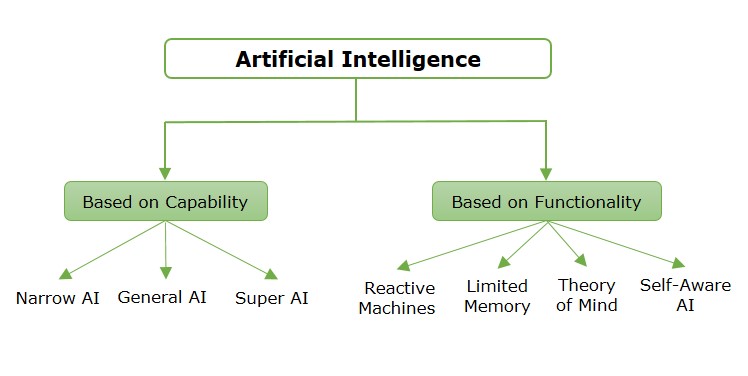
    Artificial Intelligence (AI) is a technology that enables computers to think and act like humans. These systems are trained to learn from past experiences to enhance speed, precision, and effectiveness. Further based on the following criteria artificial intelligence can be categorized into different types −

    Types of Artificial Intelligence

    Based on Capabilities

    AI is classified into the following types based on capabilities −

    Normal AI (Weak AI)

    Narrow AI is a type of AI that enables to perform a specific task with intelligence. Narrow AI is trained only for a specific task and fails to perform beyond its limitations.

    Voice assistants like AppleSiri, Alexa, and others are a good example of Narrow AI, as they are trained to operate within a limited range of functions. Some of the other examples of Narrow AI are chess games, facial recognition, and recommendation engines.

    General AI (Strong AI)

    General AI is a type of AI that enables to perform intellectual tasks as efficient;y as humans. The systems are trained to have the capability to understand, learn, adapt, and think like humans.

    Though it seems efficient, the General AI still seems to be a theoretical concept that researchers aim to develop in the future. It is quite challenging, as the system should be trained to be self-conscious, to get aware of the surroundings, and to make independent decisions. The potential applications could be robots.

    Super AI

    Super AI is a type of AI that surpasses human intelligence and can perform any task better than humans. It is an advanced version of general AI, where machines make their own decisions and solve problems by themselves.

    Such AI would not only perform tasks but also understand and interpret emotions and respond like humans. While it remains hypothetical, development of such models would be complex.

    Based on Functionality

    AI is classified into the following types based on the functionality −

    Reactive Machines

    Reactive Machines are the most basic type of artificial intelligence. These machines operate only on the present data and do not store any previous experiences or learn from past actions. Additionally, these systems respond to specific inputs with predetermined outputs and cannot be changed.

    IBM’s Deep Blue is a great example of reactive machines. It is the first computer system to defeat a reigning world chess champion, Garry Kasparov. It could identify pieces on the board and make predictions but could not store any memories or learn from the past games.

    Google’s AlphaGo is another example of a reactive machine, playing the board game Go with a similar method of pattern recognition without gaining knowledge from previous games.

    Limited Memory

    Limited Memory is the most used category in most modern AI applications. It can store past experiences and learn from them to improve future outcomes. These machines store historical data to predict and make decisions but do not have long-term memory. Major applications like autonomous systems and robotics often rely on limited memory.

    Chatbots is an example of limited memory, where it can remember recent conversations to improve the flow and relevance. Additionally, self-driving cars is another example that observes the road, traffic signs, and surroundings to make decisions based on past experiences and current conditions.

    Theory of Mind

    Theory of Mind could understand the human emotions, beliefs, and intentions. While this type of AI is still in development, it has enabled machines to interpret emotions accurately and modify behavior accordingly so that machines could interact with humans effectively. Some of the possible applications of this type are probably collaborating robots and human-robot interaction.

    Self-Awareness

    Self-Aware AI represents the future of artificial intelligence with self-consciousness and awareness similar to humans.While we are far from achieving the goal of self-aware AI, it is an important objective for the development of AI. The applications of self-aware AI could be fully autonomous systems that could take moral and ethical decisions.

  • Artificial Intelligence – History & Evolution

    Artificial Intelligence is a technology that makes machines replicate human intelligence. These machines can learn, make decisions, adapt, and perform tasks similar to humans. The history and evolution of AI is a journey that spans several decades. This chapter gives you a concise overview of key milestones throughout the years.

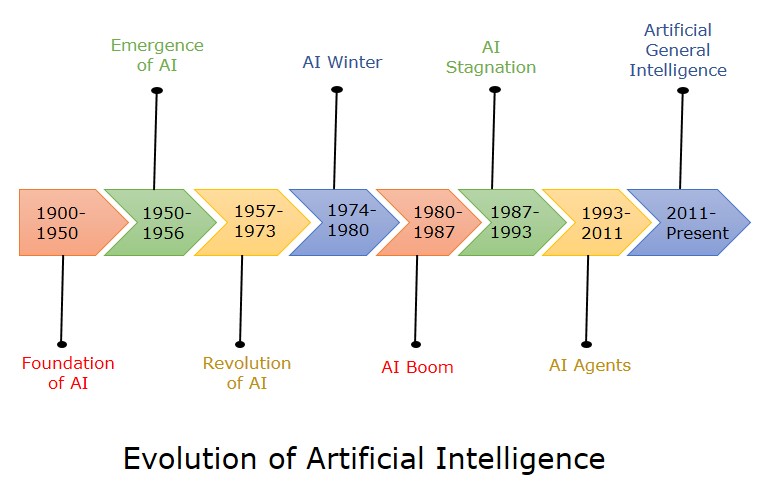
    There is an assumption that Artificial Intelligence is a recent technology in the market, but in reality the groundwork of AI dates back to early 1900s, while the biggest innovations weren’t made until 1950’s.

    Evolution of AI

    Foundation of AI

    The early 1900’s, i.e., 1900-1950 is when there was a lot of buzz created regarding the idea of artificial humans. This made scientists of all sorts think if it was possible to create an artificial brain. Though most of them tried creating the simpler versions of robots. Some of the key milestones in this period are −

    YearMilestone
    1921Czech playwright Karel Capek released a science fiction play “Rossum’s Universal Robots”, where he introduced artificial people and named them robots.
    1943Warren McCulloch and Walter Pitts created the first conceptual model of a neural network.

    Emergence of AI

    The years from 1950-1956 marked the turning point for AI. Researchers and companies made Some of the key milestones in this period are −

    YearMilestone
    1950Alan Turing published “Computer Machinery and Intelligence” which proposed Turing test to measure the intelligence of a machine.
    1952Arthur Samuel is a computer scientist, who developed a program to play checkers, which improved its performance through experience.

    AI Revolution

    The period from 1957-1973 was also commonly known as “Golden Age” as most researchers showed interest and enthusiasm to achieve remarkable advancements in the field. Some of the notable milestones in this period are −

    YearMilestone
    1957Frank Rosenblatt introduced perceptron, which was one of the early innovation for artificial neural networks.
    1958John McCarthy created LISP, the first programming language for AI research.
    1959Arthur Samuel used the term “Machine Learning” and defined it as intellectual computers that surpass humans in any task.
    1966Joseph Weizenbaum created ELIZA, that used natural language processing to make conversations with humans.
    1972Alain Colmerauer and Philippe Roussel developed prolog programming language.

    AI Winter

    The initial AI winter occurred from 1974-1980 , which was quite a tough time for the improvement of AI. During this time, there was a substantial decrease in research funding which affected the interest on AI.

    AI Boom

    The time period from 1980-1987 showed a period of rapid growth and interest in AI. This happened because of both research breakthroughs and additional government funding to support the researchers. Some of the key milestones in this period are −

    YearMilestone
    1980The first expert systems, know as XCON came into the commercial market.
    1981The Japanese government alocated $850 million to the development of Fifth Generation Computer Project, to create computers that could translate, converse in human language and express reasoning on a human level.
    1984The AAAI warns about the incoming AI Winter, where the funding and interest would decrease significantly effecting the research.
    1986Ernst Dickmann and his team demonstrated the first self-driving cars, which drove up to 55kmph with no obstacles and human driver.

    AI Stagnation

    The second AI winter took place from the years 1987-1993, where again investors and government stopped funding due to high cost and no efficient results.

    AI Agents

    The years between 1993-2011, there was a significant growth in AI, especially with the development of intelligent computer programs. In this era, professional focused on developing software to match human intelligence for specific tasks. Some of the key milestones in this period are −

    YearMilestone
    1997Deep Blue was the first program to beat a human chess champion, Gray Kasparov.
    2000Professor Cynthia Breazeal the first robot named Kismetthat could simulate human emotions and had facial features similar to humans.
    2003NASA landed two rovers onto Mars, which navigated through the surface of the planet without human intervention.
    2006Companies such as Twitter, Facebook, and Netflix started using AI as part of advertising, business analysis, and user engagement.
    2011Apple released Siri, the first popular voice assistant.

    Artificial General Intelligence

    From 2011 to present, unfolded significant advancements within AI domain. These achievements can linked to extensive data application, and the ongoing interest on artificial general intelligence(AGI). Some of the key milestones in this period are −

    YearMilestone
    2012Google researchers Jeff Dean and Andrew Ng trained a neural network to recognize cats using unlabeled images without prior information.
    2016Hanson Robotics introduced Sophia, the first humanoid robot with realistic human features, emotion recognition, and communication abilities.
    2017Facebook programmed two AI Chatbot to communicate and learn to negotiate, but as the conversation went on they eventually stopped using English and started speaking their own language entirely on their own.
    2018A Chinese tech group Alibaba’s language − processing AI won over human intellect on a Standford reading and comprehension test.
    2019Google’s AlphaStar reached Grandmaster on the video game StarCraft 2 outperforming all but .2% of human players.
    2020OpenAI started beta testing GPT-3, a model that uses Deep Learning to create code, content, and other creative tasks.
    2021OpenAI developed Dall-E, which can generate images using the natural language as prompts.
    2022Dall-E was integrated with ChatGPT, showcasing AI’s capacity to generate text and relevant images.
    2023Multimodal is another major breakthrough in AI. These models process all the data types like text, image, video, and audio simultaneously.
    2024Devin is the first AI software engineer still under development and SORA is another innovation of OpenAI which is an text-to-video model.
  • Artificial Intelligence – Overview

    Since the invention of computers or machines, their capability to perform various tasks has continued to increase rapidly. Humans have achieved the power of computer systems in terms of their diverse working domains, their increasing speed, and reducing size with respect to time. A branch of computer science named Artificial Intelligence is to build machines or computers that are as intelligent as people.

    What is Artificial Intelligence?

    Artificial intelligence is the technology that allows systems to replicate human behavior and thoughts. At its core, AI uses algorithms to train datasets that will generate AI models that let computer systems perform tasks like recommending songs, googling route directions, or providing text translations betweentwo languages. A few examples of AI are ChatGPTGoogle Translate, Tesla, Netflix, and many more.

    According to the father of artificial intelligence, John McCarthy, it is The science and engineering of making intelligent machines, especially intelligent computer programs..

    History of AI

    Artificial Intelligence has evolved since its inception in the mid-20th century. Initially, AI focused on automating simple tasks, and with advancements in machine learning and deep learning, it made significant improvements in understanding and processing data. Today, AI influences various fields, including healthcare, finance, and automobiles. Some of the key milestones in the history of AI are −

    YearMilestone
    1923Karel apek play named Rossum’s Universal Robots (RUR) opens in London, first use of the word “robot” in English.
    1956John McCarthy, a professor at Dartmouth College coined the term “Artificial Intelligence”.
    1966Joseph Weizenbaum created ELIZA, that used natural language processing to make conversations with humans.
    1997Deep Blue was the first program to beat a human chess champion, Gray Kasparov.
    2012AlexNet is a convolution neural network (CNN) architecture that was designed by Alex Krizhevsky.
    2020OpenAI started beta testing GPT-3, a model that uses deep learning to create code, content, and other creative tasks.

    Goals of AI

    The potential of AI is basically to mimic human skills and traits and apply them to machines. While the main objective of AI is to create a core technology that is able to allow computer systems to process intelligently and independently. Below are the essential goals of AI −

    • To Create Expert Systems
    • To Implement Human Intelligence in Machines
    • To Develop Problem-Solving Ability
    • To Allow Continuous Learning
    • To Encourage Social Intelligence and Creativity

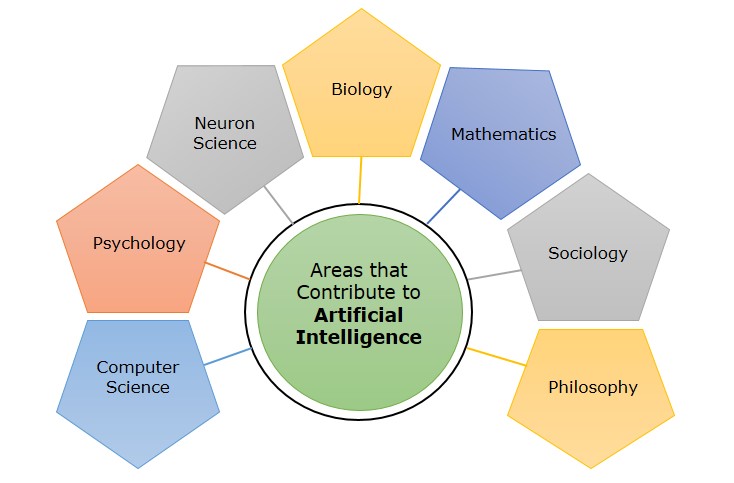
    What Contributes to AI?

    AI is a field that combines various scientific and technological disciplines, which include Computer Science, Biology, Psychology, Linguistics, Mathematics, and Engineering. The main objective of AI is to develop computer programs that can perform tasks with reasoning, learning, and solving problems similar to human intelligence.

    Components of AI

    AI Programming vs. Traditional Coding

    Below is the difference between AI programming and traditional coding −

    AI ProgrammingTraditional Coding
    Can deal with complex, undefined problems.Can handle only well-defined, predictable problems.
    Uses data-driven methods and algorithms.Relies on explicit logic and rules.
    Produces models that make predictions or decisions.Generates specific functional software
    Utilizes frameworks and libraries like TensorFlowPyTorch.Commonly uses languages like PythonJava.
    Involves validation of model accuracy.Focuses on debugging and unit testing.
    Models learn patterns from data.Programs execute pre-defined instructions.

    What is an AI Technique?

    AI techniques refer to methods and algorithms that are used to create smart systems that perform tasks requiring human-like intelligence. Some of these techniques are Machine LearningNatural Language ProcessingComputer Vision and others. These AI techniques use the knowledge efficiently in such a way that −

    • It should be perceivable by the people who provide it.
    • It should be easily modifiable to correct errors.
    • Elevate the speed of execution of the complex program it is equipped with.

    Applications of AI

    AI has been dominant in the following fields −

    • Gaming − AI plays a crucial role in strategic games such as chess, poker, tic-tac-toe, etc., where machine can think of large number of possible positions based on heuristic knowledge.
    • Natural Language Processing − It enables machines to interact with humans in natural language.
    • Expert Systems − It is an AI based software that enables decision-making ability similar to a human expert.
    • Computer Vision − These systems understand, interpret, and comprehend visual input on the computer.
    • Speech Recognition − Some intelligent systems are capable of hearing and comprehending the language in terms of sentences and their meanings while a human talks to it. It can handle different accents, slang words, noise in the background, change in humans noise due to cold, etc.
    • Handwriting Recognition − The handwriting recognition software reads the text written on paper by a pen or on screen by a stylus. It can recognize the shapes of the letters and convert it into editable text.
    • Intelligent Robots − Robots are able to perform the tasks given by a human. They have sensors to detect physical data from the real world such as temperature, movement, and sound. They have efficient processors, and huge memory, to exhibit intelligence. In addition, they are capable of learning from their mistakes and they can adapt to new environment.

    Challenges in AI

    The main challenges in implementing AI includes −

    • Data Quality and Accessibility − AI requires large, high-quality, and relevant datasets for effective learning.
    • Technical Expertise − Implementing AI algorithms and models requires skilled professionals.
    • Ethical and Legal Concerns − It is important to make sure that the AI systems are fair, unbiased, and don’t harm anyone’s safety.
    • Integration − Integrating AI with existing systems can be complex.
    • Cost − Developing and maintaining of AI infrastructure can be expensive.

    Future of AI

    As technology advances, we could witness greater integration of AI into our lives, and a more interactive relationship between humans and AI. Along with technology advancement is the need for ethical and privacy considerations including bias, privacy, and job displacement to help ensure that AI is beneficial to society as a whole.

    The four key trends that define the future of AI include −

    • Rise of Multimodal
    • Emergence of Agentic platforms for AI Deployment
    • Optimization of AI’s performance
    • Democratize AI Access.

    Some of the other notable AI technologies that are going to shape various industries in the near future are rapid development of Generative AI and highlighting its transformative impact on various various industries.

  • Artificial Intelligence Tutorial

    This artificial intelligence tutorial provides introductory knowledge on Artificial Intelligence. It would be a great help if you are about to select Artificial Intelligence as a course subject. You can briefly learn about the areas of AI in which research is prospering.

    This tutorial provides a good understanding of the workings of AI and its applications. This tutorial would be a good choice for someone who is a beginner and also for someone who would want to know more about it.

    What is Artificial Intelligence?

    Artificial Intelligence(AI) is that branch of computer science that creates intelligent machines that think and act like humans. It is one of the revolutionizing technologies that people are fascinated by because of its ability to relate to their daily lives. AI enables machines to think, learn and adapt, to enhance and automate tasks across industries.

    Artificial Intelligence has many subsets that focus on different aspects of mimicking human beings. Machine learning is one of the popular subsets, whereas the others included are Deep LearningNatural Language Processing, and Robotics.

    Features of Artificial Intelligence

    Artificial Intelligence is a technology that aims at replicating human intelligence. It has numerous applications across various sectors, from enhancing customer experiences to disease diagnosis. Some key features of AI are:

    • Ability to learn − AI systems can improve their performance eventually by learning from data and past experiences.
    • Logical decision making − AI systems are fed with large amounts of data to understand and recognize patterns for analysis and decision making.
    • Adaptability − AI systems can adjust and adapt to changes in data.
    • Efficient automation − AI would efficiently execute repetitive tasks and processes.
    • Versatility − AI can be widely applied for various tasks across all fields like businesses, automotive, health, and many others.

    Why to Learn Artificial Intelligence?

    AI is one of the growing technologies, and learning AI would help build a career in a field that is high in demand. It opens up to various job opportunities and helps you stay intent with evolving technologies. It enhances problem solving skills, automates processes and can be applied to various industries, from business to health care.

    Who Should Learn Artificial Intelligence?

    This tutorial is prepared for students at the beginner level who aspire to learn Artificial Intelligence.

    This course is also helpful for professionals aiming to enhance their skills or an entrepreneur trying to integrate AI with their business. Professionals in software development, data science, and engineering would find this artificial intelligence tutorial especially relevant to enhance their careers.

    Applications of Artificial Intelligence

    AI is transforming various industries with its ability to automate, make decisions, and enhance the efficiency of various tasks. As it is known for its versatility, some of its applications are:

    • Health care − AI in healthcare is used to assist in tasks like diagnosing diseases, personalizing treatments and drug discovery.
    • Finance − AI is used for fraud detection, trading and stock market analysis and customer service through chatbots.
    • Manufacturing and Industries − AI optimizes production processes, improves quality and identifies machinery failure.
    • Agriculture − AI helps combine technology with agriculture by analyzing soil conditions.
    • Transportation − AI helps in designing autonomous vehicles. Some other tasks include traffic management and route optimization in maps.
    • Customer Service − Chatbots and Virtual assistants are AI applications to improve user engagement.
    • Entertainment and Media − AI helps in content creation, personalized content recommendations, and target advertising.
    • Safety and Security − AI enhances threat detection and automates security measures.

    Jobs and Opportunities

    Many companies require highly skilled individuals in AI. As companies integrate AI into their operation, there will be a need for individuals to implement it. Some roles that companies hire are:

    • Machine learning engineer
    • Data Scientist
    • AI Research Scientist
    • Computer Vision Engineer
    • NLP Engineer
    • AI Product Manager
    • AI Marketing Specialist

    Prerequisites to Learn Artificial Intelligence

    The basic knowledge of Computer Science is mandatory. Knowledge of science, mechanical engineering, or electrical engineering is a plus.

    Before deep diving into Artificial Intelligence, there are a few skills and concepts that one should focus on, which includes −

    • Mathematics and Statistics
    • Knowledge of any programming language such as Python or R.
    • Basics on Data Structures and Data Handling Techniques

    Getting Started with Artificial Intelligence

    Getting started to learn AI involves a few steps, which helps build a solid foundation. Here is a brief guide on the steps that can make you strong in the fundamentals of AI:

    • Master Prerequisites − AI is complex, so you can only get deep into the technology if you have interest and enthusiasm. The first step is to master prerequisites, which include an understanding of basic mathematics and statistics along with learning a programming language and data structures.
    • Learn AI algorithms −Artificial Intelligence is all about algorithms like searching and sorting. So if you get familiar with algorithms, you can ace AI.
    • Getting to know AI tools and frameworks −The final step would be learning to handle AI frameworks. This is a practical step and requires prior theoretical knowledge. Some popular tools and libraries used to develop and deploy AI models are NumPy, Pandas, Matplotlib.
    • Practice with Real data −Practicing AI algorithms on real data that is collected from various websites or APIs would help understand the working of AI in real-time scenarios.

    Frequently Asked Questions about Artificial Intelligence

    There are some very Frequently Asked Questions(FAQ) about Artificial Intelligence, this section tries to answer them briefly.What is Artificial Intelligence?

    chevron

    Why is artificial Intelligence important?

    chevron

    What are the types of artificial intelligence?

    chevron

    What are the applications of AI?

    chevron

    What is the future of AI?

    chevron

    How to Learn Artificial Intelligence

    chevron

    Can AI take over the world?

    chevron

    Who invented Artificial Intelligence?

    chevron

    How to Use Artificial Intelligence in Mobile Apps?

    chevron

    How is AI used in education?

    chevron

    What are the risks of artificial intelligence?

    chevron

    Artificial Intelligence Articles

    You can explore a set of Artificial Intelligence articles at Artificial Intelligence Articles.

  • Discuss Machine Learning

    Todays Artificial Intelligence (AI) has far surpassed the hype of blockchain and quantum computing. The developers now take advantage of this in creating new Machine Learning models and to re-train the existing models for better performance and results. This tutorial will give an introduction to machine learning and its implementation in Artificial Intelligence.

  • Machine Learning (ML) Interview Questions and Answers

    If you are preparing for an machine learning (ML) interview, this guide provides the top 50+ machine learning interview questions and answers along with the detailed explanation covering from basics to advanced ML concepts.

    These ML interview questions and answers are helpful for both freshers as well as experienced professionals. We have divided these questions into the following categories:

    • Basic ML Concepts Interview Questions
    • Intermediate ML Interview Questions
    • Advanced ML Interview Questions
    • Problem-Solving & Application-Oriented ML Interview Questions

    Basic Machine Learning Interview Questions and Answers

    1. Define Machine Learning?

    Machine learning (ML) is a branch of AI that uses data to find patterns, make predictions or decisions without explicit program and advanced algorithms to enable machines to learn and response like a human. Machine learning is a branch of AI that enables systems to learn

    2. What is supervised learning?

    In supervised learning, a model is trained on labelled dataset for training. It is well known classification model. Some of the key supervised learning algorithms are Linear Regression, Logistic Regression, Decision Trees, Random Forest, Support Vector Machines (SVM) and k-Nearest Neighbors (KNN).

    3. What is unsupervised learning?

    A machine learning model which is trained on unlabelled dataset for training is known as unsupervised learning. In unsupervised learning, algorithm identifies patterns, structures, or relationships within the data without pre-defined categories or labels. Common techniques include clustering, dimensionality reduction, and anomaly detection.

    4. What is overfitting?

    Overfitting occurs when a model learns noise from training data, resulting in poor generalization to unseen data. Hence, when a model performs well on training data but not well on test data or new data; this occurrence is known as Overfitting. Regularization, cross-validation, and pruning are some possible solutions to avoid Overfitting.

    5. What is underfitting?

    Underfitting happens when a model is too simple to capture data patterns and unable to find the relationship between the input and output variables in a dataset resulting in poor performance on both training and test sets.

    6. How do you prevent overfitting?

    Use techniques like cross-validation, regularization, early stopping, and adding more training data are most prominent methods to prevent overfitting.

    7. Explain different methods to overcome overfitting in AI model?

    Some of the most commonly used techniques to prevent overfitting are techniques are cross-validation, regularization, early stopping. A brief description of these is as −

    • Cross-validation − Cross-validation helps to prevent overfitting by dividing the data into multiple subgroups, training the model on each subset, and verifying it on the remaining data to ensure that it generalizes well to new data.
    • Regularization − Regularization slightly reduces in training accuracy for a gain in generalizability. It uses different strategies to reduce overfitting in machine learning models.
    • Early stopping − Early stopping prevents overfitting by halting training once the model’s performance on a validation set starts to degrade, ensuring it doesn’t learn noise from the training data.

    8. What is bias-variance tradeoff?

    Its the balance between model complexity and accuracy, where high bias leads to underfitting and high variance leads to overfitting.

    9. What is regularization?

    Regularization slightly reduces in training accuracy for a gain in generalizability. It uses different strategies to reduce overfitting in machine learning models. Regularization adds a penalty to the loss function to reduce model complexity, helping prevent overfitting (e.g., L1, L2 regularization).

    10. What is the difference between L1 and L2 regularization?

    L1 regularization, also known as Lasso regularization, adds the absolute values penalty of the model’s coefficients to the loss function. It promotes sparsity. L2 regularization, also known as Ridge regularization, adds the squared penalty of the model’s coefficients to the loss function. It reduces large weights smoothly.

    11. What is the curse of dimensionality in Machine Learning?

    The curse of dimensionality states that as the number of dimensions or features in a dataset rises, the data space expands exponentially. This expansion causes data to become sparse, making effective analysis harder.

    12. Why is feature scaling important in machine learning?

    Feature scaling is an important pre-processing step in machine learning that entails converting numerical features to a common scale. It contributes significantly to accurate and efficient model training and performance. Scaling strategies seek to normalize the range, distribution, and size of features, decreasing any biases and inconsistencies caused by variances in their values. Overall, Feature scaling standardizes data, improving convergence in gradient-based models and distance-based algorithms.

    13. What is Normalization?

    Normalization, a key component of Feature Scaling, is a data preparation technique used to standardize the values of features in a dataset and bring them to a similar scale. This method improves data analysis and modeling accuracy by reducing the impact of different sizes on machine learning models. It can be measured using following formula −

    X′=X−XminXmax−Xmin

    14. What is Standardization?

    Standardization is feature scaling method in which values are centred around the mean and have a unit standard deviation. This signifies that the attribute’s mean becomes zero, resulting in a distribution with a unit standard deviation. It can be measured using following formula −

    X′=X−μσ

    Here, μ is a mean value of feature values and σ is the standard deviation of the feature values.

    15. Whats the difference between normalization and standardization?

    Normalization adjusts data to a specified range, often [0, 1], by modifying each feature’s minimum and maximum values. It is beneficial when features have different sizes and distance-based techniques are used, whereas standardization converts data to have a mean of zero and a standard deviation of one. It preserves the form of the original distribution and is typically employed when features have multiple dimensions or the data follows a Gaussian (normal) distribution.

    16. What is feature selection?

    Feature selection is a process of selecting the most relevant features from a dataset to improve model performance, reduce overfitting, and reduce computing cost. It allows models to focus on relevant input variables, improving accuracy and efficiency in machine learning tasks. Feature selection identifies the most important features, reducing model complexity and potentially improving performance.

    17. What is PCA?

    Principal Component Analysis (PCA) is a dimensionality reduction technique that transforms data into components capturing maximum variance. PCA is not only reduces dimensions but also capture the majority of the data’s variance. It is frequently used to simplify complex datasets, reduce noise, and enhance computational efficiency in machine learning applications.

    18. What is cross-validation?

    Cross-validation is a strategy for evaluating the performance of machine learning model that involves splitting the dataset into various subsets, training the model on some of them, and testing it on others. This improves the model’s generalizability and lowers overfitting by allowing for more reliable evaluation across multiple data splits.

    19. What is imputation?

    Imputation in machine learning is the process of replacing missing or incomplete values in a dataset with replaced values such as the mean, median, mode, or projections based on other attributes. This helps to maintain dataset integrity, allowing models to learn on entire data without being biased by missing elements.

    20. How do you handle imbalanced data?

    To deal with imbalanced data in machine learning, you can use techniques like resampling, synthetic data generation (SMOTE), or cost-sensitive learning to handle imbalanced datasets. Performance metrics is also well suited for imbalance, such as F1-score, precision-recall, or AUC-ROC.

    21. What is data augmentation?

    Data augmentation is a machine learning technique that adds variation to training data by introducing modifications like rotations, flips, or noise to existing samples. This improves model generalization, particularly in image and natural language processing applications, by allowing the model to learn robust features from a variety of data.

    22. Define multicollinearity.

    In a regression model, when two or more independent variables have a strong correlation with one another, making it difficult to evaluate each independent variable’s effect on the dependent variable is known as multicollinearity.

    23. What is one-hot encoding?

    One-hot encoding is a method of describing categorical data as numerical vectors in which each distinct category is represented by a binary number like 0 and 1; where 1 indicates presence and 0 indicates absence. It is a common approach to deal with categorical data in machine learning.

    24. Why data cleaning is crucial for Machine Learning Models?

    Data cleaning is a process of correcting or deleting inaccurate, corrupted, poorly formatted, duplicate, or incomplete data from a dataset. If the data is inaccurate, the outcomes and algorithms are untrustworthy, even if they appear in a proper form. Data cleaning is crucial because it provides consistency in a data set and allows you to get trustworthy findings from analysis you perform on it.

    25. What is the difference between data cleaning and data transformation?

    Data cleaning is a process of finding and fixing or deleting flaws, inconsistencies, and inaccuracies in raw data to ensure its accuracy and completeness. Data transformation, on the other hand, is changing data from one format or structure to another, usually in order to prepare it for analysis or make it compatible with multiple systems.

    Intermediate Machine Learning Interview Questions and Answers

    26. What is linear regression?

    Linear regression is a statistical method used to find the relationship between a dependent variable and one or more independent variables by fitting a linear equation to observed data.

    27. What is logistic regression?

    Logistic regression is a classification algorithm that predicts probabilities using a logistic function. It estimates the probability of an event occurring, such as success or failure of an event, based on a given data of independent variables.

    28. What is the difference between classification and regression?

    Classification is a process of predicting discrete labels or classes like to detecting an email whether it is spam or not and producing categorical results. Regression, on the other hand, predicts continuous values like to predict house or stock prices with numerical outputs. Classification predicts discrete labels, while regression predicts continuous values. Overall, classification is about assigning labels, while regression is about predicting values.

    29. Define decision trees.

    A decision tree is a non-parametric supervised learning technique used for classification and regression. It divides data into branches based on feature values and makes predictions or classifications. It has a hierarchical tree structure that includes a root node, branches, internal nodes, and leaf nodes. Each node represents a decision point, splitting data depending on the best feature, and each branch leads to more splits until it reaches a leaf node, which produces prediction or result.

    30. What is a random forest?

    Random forest is a machine learning algorithm that builds multiple decision trees during training and combines their outputs to improve accuracy and reduce overfitting. Each tree in the forest is trained on a random subset of data, with random features chosen at each split, allowing the ensemble to capture diverse patterns. The final prediction is made by averaging (for regression) or voting (for classification) across all trees.

    31. What is gradient boosting?

    Gradient boosting is an ensemble machine learning technique that combines the predictions from multiple weak learners, typically decision trees, to form a robust predictive model. It creates models in a sequential manner, with each new model attempting to correct errors by minimizing the gradient of the loss function.

    32. What is k-means clustering?

    K-means clustering is an unsupervised machine learning approach that divides data into k different groups or clusters based on feature similarity. It iteratively assigns data points to clusters by reducing the distance between each point and the cluster center, and then updates the centers until the clusters are stable.

    33. What is K-Nearest Neighbors (KNN)?

    K-Nearest Neighbors (KNN) is a supervised machine learning technique used for classification and regression. It classifies data points based on the majority label of the “k” nearest data points in the feature space, then makes predictions by comparing new occurrences to previously known ones. The choice of “k” and distance metric affects its accuracy.

    34. What is Naive Bayes?

    Naive Bayes is a probabilistic machine learning technique based on Bayes’ theorem. It implies that features are independent of one another and is widely used for classification tasks such as spam detection and sentiment analysis due to its efficiency and performance on large datasets.

    35. What is SVM (Support Vector Machine)?

    Support Vector Machine (SVM) is a supervised machine learning technique used for classification and regression. It works by determining the best hyperplane that separates data points from distinct classes with maximum margin. SVMs are extremely effective in high-dimensional spaces and clear separation exists between classes.

    Advance Level Machine Learning Interview Questions and Answers

    36. What is a neural network?

    neural network is a deep learning model which mimic like a human brain and nervous system. It mainly consist nodes, or artificial neurons and three layers – an input layer, one or more hidden layers, and one output layer.

    37. Define deep neural network?

    A deep neural network (DNN) is an artificial neural network that includes multiple layers of interconnected nodes (neurons), each of which learns to extract progressively complicated features from the input data. It is an important architecture in deep learning since it enables models to automatically learn patterns and make predictions from large datasets.

    38. What is an activation function?

    An activation function determines that which neurons are triggered when information flows over the network’s layers. It is an essential component of neural networks, allowing them to learn complex patterns in data. Some of the most popular and commonly used activation functions in neural networks are ReLU, Leaky ReLU, Sigmoid, Tanh, and Softmax.

    39. Define backpropagation.

    Backpropagation is a deep learning technique that optimizes neural networks. The gradient of the loss function with respect to each weight is calculated using the chain rule, and the weights are then adjusted in the direction that minimizes the loss. This procedure is repeated iteratively throughout training to increase the model’s accuracy.

    40. What is a convolutional neural network (CNN)?

    A Convolutional Neural Network (CNN) is a deep learning model that is effectively work for image related datasets. It is made up with layers that automatically recognize features using convolutional filters, followed by pooling layers to reduce dimensionality and fully connected layers for classification or regression.

    41. What is a recurrent neural network (RNN)?

    RNNs process sequential data by retaining information from previous steps, useful in time-series and NLP. A Recurrent Neural Network (RNN) is a type of neural network that processes sequential data by keeping track of previous inputs using internal states. It is especially beneficial in applications that need data ordering, such as time series prediction, natural language processing, and speech recognition.

    42. What is overfitting in neural networks?

    When a model performs well on training data but not well on test data or new data; this occurrence is known as Overfitting. Regularization, cross-validation, and pruning are some possible solutions to avoid Overfitting.

    43. What is dropout?

    Dropout is a deep learning regularization method in which randomly selected neurons are dropped out with a specific probability during training. This helps to prevent overfitting by forcing the network to acquire redundant representations, resulting in better generalization to new data.

    44. What is batch normalization?

    Batch normalization is a deep learning approach for normalizing the input of each layer in a neural network by modifying and scaling activations. It improves training speed, stability, and performance by minimizing internal covariate shift, resulting in more constant gradient flows during training.

    45. What is a GAN (Generative Adversarial Network)?

    Generative Adversarial Network (GAN) is a deep learning model made up of two neural networks, a generator and a discriminator. The generator generates fake data, while the discriminator tries to tell the difference between actual and fake data. The two networks compete and improve each other until the generator produces accurate data.

    Problem-Solving & Application Oriented Machine Learning Interview Questions and Answers

    46. What is model deployment?

    Model deployment in machine learning is a process of integrating a trained model into a real scenario to make real-time predictions or choices based on new data. This includes getting the model ready for usage, assuring scalability, and monitoring its performance over time.

    47. What is hyperparameter tuning?

    In machine learning, hyperparameter tuning is the process of determining the ideal combination of hyperparameters (settings or configurations) for a model in order to optimize performance. It entails experimenting with different values for hyperparameters such as learning rate, batch size, and regularization strength, often using techniques such as grid search or random search.

    48. What is grid search?

    Grid search is a hyperparameter optimization strategy in machine learning that trains and evaluates a model on a predefined set of hyperparameter combinations. It searches systematically through all possible combinations of supplied hyperparameters to determine the optimal configuration based on performance metrics.

    49. What is random search?

    Random search is a hyperparameter optimization strategy that selects random combinations of hyperparameters from a predetermined search space. It is frequently used in machine learning to determine the optimal model configuration, particularly when the search space is huge and grid search is computationally expensive.

    50. What are ensemble methods?

    Ensemble methods combine multiple models to improve accuracy and robustness (e.g., bagging, boosting).