Multilevel inheritance is a type of inheritance, where a class is derived from another derived class, creating a chain of inheritance that allows it to pass down its properties and behaviors through multiple levels of classes or inherit from its predecessor.
Implementing Multilevel Inheritance
To implement multilevel inheritance, define classes in a hierarchical manner, where one class inherits from another.
Syntax
The syntax of multilevel inheritance in C++ −
classbaseClass{//Here's a base class members};classderivedClass1:public baseClass{// Members of derivedClass1};classderivedClass2:public derivedClass1{// Members of derivedClass2};
Here,
- baseClass is the top-level class from where other classes derive.
- derivedClass1 is the class that inherits from baseClass.
- derivedClass2 Inherits from derivedClass1, creating a multilevel structure.
Block Diagram of Multilevel Inheritance
See the below block diagram demonstrating multilevel inheritance −
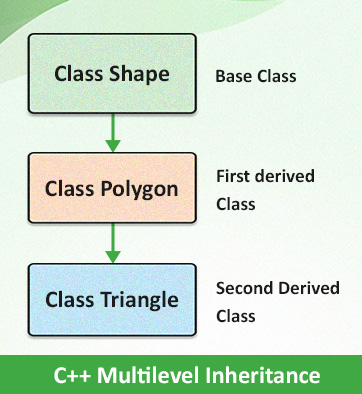
As per the above diagram, “Shape” is the base class, and it is deriving over to “Polygon” class, and “Polygon” class is further deriving over “Triangle” class in order to implement multilevel inheritance.
Example of Multilevel Inheritance
In the following example, we are implementing multilevel inheritance −
#include <iostream>usingnamespace std;// Base classclassShape{public:voiddisplay(){
         cout <<"This is a shape."<< endl;}};// First derived classclassPolygon:public Shape{public:voidsides(){
         cout <<"A polygon has multiple sides."<< endl;}};// Second derived classclassTriangle:public Polygon{public:voidtype(){
         cout <<"A triangle comes under a three-sided polygon."<< endl;}};intmain(){
   Triangle myTriangle;

   myTriangle.display();// From Shape
   myTriangle.sides();// From Polygon
   myTriangle.type();// From Trianglereturn0;}
Output
This is a shape.
A polygon has multiple sides.
A triangle comes under a three-sided polygon.
Explanation
- Firstly, a base class named Shape has been created with a public method display(), which prints “This is a shape.”
- Next, the first derived class named Polygon inherits from the Shape (or base class), meaning it gains access to the members of the Shape class, including the display()
- The second derived class, named Triangle, inherits from the Polygon class, which allows Triangle to use both display() and sides() methods.
Main Function
- An instance of a Triangle named myTriangle is created.
- display() will first access the display() method by calling the Triangle class and then the Shape class because of inheritance.
- Similarly, sides() will inherit from sides() of the Polygon class,
- and myTriangle.type() from type() of Triangle class
Leave a Reply