A switch statement allows a variable to be tested for equality against a list of values. Each value is called a case, and the variable being switched on is checked for each case.
Syntax
The syntax for a switch statement in C++ is as follows −
switch(expression){case constant-expression :statement(s);break;//optionalcase constant-expression :statement(s);break;//optional// you can have any number of case statements.default://Optionalstatement(s);}
The following rules apply to a switch statement −
- The expression used in a switch statement must have an integral or enumerated type, or be of a class type in which the class has a single conversion function to an integral or enumerated type.
- You can have any number of case statements within a switch. Each case is followed by the value to be compared to and a colon.
- The constant-expression for a case must be the same data type as the variable in the switch, and it must be a constant or a literal.
- When the variable being switched on is equal to a case, the statements following that case will execute until a break statement is reached.
- When a break statement is reached, the switch terminates, and the flow of control jumps to the next line following the switch statement.
- Not every case needs to contain a break. If no break appears, the flow of control will fall through to subsequent cases until a break is reached.
- A switch statement can have an optional default case, which must appear at the end of the switch. The default case can be used for performing a task when none of the cases is true. No break is needed in the default case.
Flow Diagram
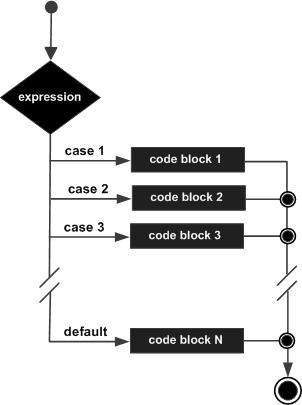
Example
#include <iostream>usingnamespace std;intmain(){// local variable declaration:char grade ='D';switch(grade){case'A':
         cout <<"Excellent!"<< endl;break;case'B':case'C':
         cout <<"Well done"<< endl;break;case'D':
         cout <<"You passed"<< endl;break;case'F':
         cout <<"Better try again"<< endl;break;default:
         cout <<"Invalid grade"<< endl;}
   cout <<"Your grade is "<< grade << endl;return0;}
This would produce the following result −
You passed
Your grade is D
Leave a Reply