Breadth First Search (BFS) Algorithm
Breadth First Search (BFS) algorithm traverses a graph in a breadthward motion to search a graph data structure for a node that meets a set of criteria. It uses a queue to remember the next vertex to start a search, when a dead end occurs in any iteration.
Breadth First Search (BFS) algorithm starts at the tree root and explores all nodes at the present depth prior to moving on to the nodes at the next depth level.
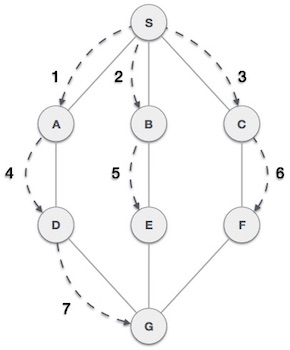
As in the example given above, BFS algorithm traverses from A to B to E to F first then to C and G lastly to D. It employs the following rules.
- Rule 1 − Visit the adjacent unvisited vertex. Mark it as visited. Display it. Insert it in a queue.
- Rule 2 − If no adjacent vertex is found, remove the first vertex from the queue.
- Rule 3 − Repeat Rule 1 and Rule 2 until the queue is empty.
| Step | Traversal | Description |
|---|---|---|
| 1 | 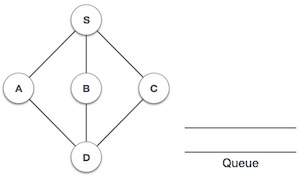 | Initialize the queue. |
| 2 | 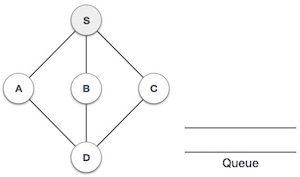 | We start from visiting S (starting node), and mark it as visited. |
| 3 | 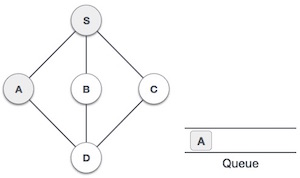 | We then see an unvisited adjacent node from S. In this example, we have three nodes but alphabetically we choose A, mark it as visited and enqueue it. |
| 4 | 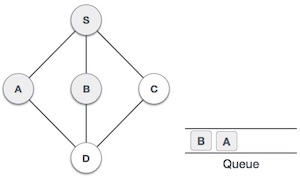 | Next, the unvisited adjacent node from S is B. We mark it as visited and enqueue it. |
| 5 | 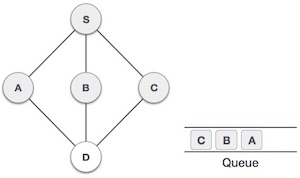 | Next, the unvisited adjacent node from S is C. We mark it as visited and enqueue it. |
| 6 | 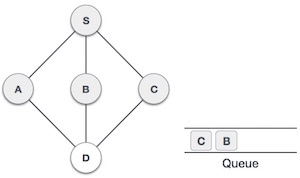 | Now, S is left with no unvisited adjacent nodes. So, we dequeue and find A. |
| 7 | 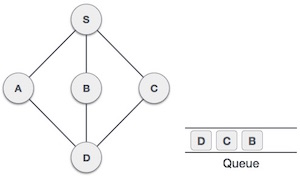 | From A we have D as unvisited adjacent node. We mark it as visited and enqueue it. |
At this stage, we are left with no unmarked (unvisited) nodes. But as per the algorithm we keep on dequeuing in order to get all unvisited nodes. When the queue gets emptied, the program is over.
Example
Following are the implementations of Breadth First Search (BFS) Algorithm in various programming languages −
#include <stdio.h>#include <stdlib.h>#include <stdbool.h>#define MAX 5structVertex{char label;
   bool visited;};//queue variablesint queue[MAX];int rear =-1;int front =0;int queueItemCount =0;//graph variables//array of verticesstructVertex* lstVertices[MAX];//adjacency matrixint adjMatrix[MAX][MAX];//vertex countint vertexCount =0;//queue functionsvoidinsert(int data){
   queue[++rear]= data;
   queueItemCount++;}intremoveData(){
   queueItemCount--;return queue[front++];}
bool isQueueEmpty(){return queueItemCount ==0;}//graph functions//add vertex to the vertex listvoidaddVertex(char label){structVertex* vertex =(structVertex*)malloc(sizeof(structVertex));
   vertex->label = label;
   vertex->visited = false;
   lstVertices[vertexCount++]= vertex;}//add edge to edge arrayvoidaddEdge(int start,int end){
   adjMatrix[start][end]=1;
   adjMatrix[end][start]=1;}//display the vertexvoiddisplayVertex(int vertexIndex){printf("%c ",lstVertices[vertexIndex]->label);}//get the adjacent unvisited vertexintgetAdjUnvisitedVertex(int vertexIndex){int i;for(i =0; i<vertexCount; i++){if(adjMatrix[vertexIndex][i]==1&& lstVertices[i]->visited == false)return i;}return-1;}voidbreadthFirstSearch(){int i;//mark first node as visited
   lstVertices[0]->visited = true;//display the vertexdisplayVertex(0);//insert vertex index in queueinsert(0);int unvisitedVertex;while(!isQueueEmpty()){//get the unvisited vertex of vertex which is at front of the queueint tempVertex =removeData();//no adjacent vertex foundwhile((unvisitedVertex =getAdjUnvisitedVertex(tempVertex))!=-1){
         lstVertices[unvisitedVertex]->visited = true;displayVertex(unvisitedVertex);insert(unvisitedVertex);}}//queue is empty, search is complete, reset the visited flag        for(i =0;i<vertexCount;i++){
      lstVertices[i]->visited = false;}}intmain(){int i, j;for(i =0; i<MAX; i++){// set adjacency for(j =0; j<MAX; j++)// matrix to 0
         adjMatrix[i][j]=0;}addVertex('S');// 0addVertex('A');// 1addVertex('B');// 2addVertex('C');// 3addVertex('D');// 4addEdge(0,1);// S - AaddEdge(0,2);// S - BaddEdge(0,3);// S - CaddEdge(1,4);// A - DaddEdge(2,4);// B - DaddEdge(3,4);// C - Dprintf("\nBreadth First Search: ");breadthFirstSearch();return0;}
Output
Breadth First Search: S A B C D
Click to check C implementation of Breadth First Search (BFS) Algorithm
Complexity of BFS Algorithm
Time Complexity
The time complexity of the BFS algorithm is represented in the form of O(V + E), where V is the number of nodes and E is the number of edges.
Space Complexity
The space complexity of the BFS algorithm is O(V).
Leave a Reply