What is Doubly Linked List?
Doubly Linked List is a variation of Linked list in which navigation is possible in both ways, forward as well as backward easily as compared to Single Linked List. Following are the important terms to understand the concept of doubly linked list.
- Link − Each link of a linked list can store a data called an element.
- Next − Each link of a linked list contains a link to the next link called Next.
- Prev − Each link of a linked list contains a link to the previous link called Prev.
- Linked List − A Linked List contains the connection link to the first link called First and to the last link called Last.
Doubly Linked List Representation
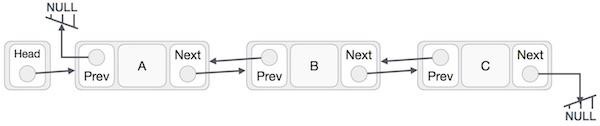
As per the above illustration, following are the important points to be considered.
- Doubly Linked List contains a link element called first and last.
- Each link carries a data field(s) and a link field called next.
- Each link is linked with its next link using its next link.
- Each link is linked with its previous link using its previous link.
- The last link carries a link as null to mark the end of the list.
Basic Operations in Doubly Linked List
Following are the basic operations supported by a list.
- Insertion − Adds an element at the beginning of the list.
- Insert Last − Adds an element at the end of the list.
- Insert After − Adds an element after an item of the list.
- Deletion − Deletes an element at the beginning of the list.
- Delete Last − Deletes an element from the end of the list.
- Delete − Deletes an element from the list using the key.
- Display forward − Displays the complete list in a forward manner.
- Display backward − Displays the complete list in a backward manner.
Doubly Linked List – Insertion at the Beginning
In this operation, we create a new node with three compartments, one containing the data, the others containing the address of its previous and next nodes in the list. This new node is inserted at the beginning of the list.
Algorithm
1. START
2. Create a new node with three variables: prev, data, next.
3. Store the new data in the data variable
4. If the list is empty, make the new node as head.
5. Otherwise, link the address of the existing first node to the
next variable of the new node, and assign null to the prev variable.
6. Point the head to the new node.
7. END
Example
Following are the implementations of this operation in various programming languages −
#include <stdio.h>#include <string.h>#include <stdlib.h>#include <stdbool.h>structnode{int data;int key;structnode*next;structnode*prev;};//this link always point to first Linkstructnode*head =NULL;//this link always point to last Linkstructnode*last =NULL;structnode*current =NULL;//is list empty
bool isEmpty(){return head ==NULL;}//display the doubly linked listvoidprintList(){structnode*ptr = head;while(ptr !=NULL){printf("(%d,%d) ",ptr->key,ptr->data);
      ptr = ptr->next;}}//insert link at the first locationvoidinsertFirst(int key,int data){//create a linkstructnode*link =(structnode*)malloc(sizeof(structnode));
   link->key = key;
   link->data = data;if(isEmpty()){//make it the last link
      last = link;}else{//update first prev link
      head->prev = link;}//point it to old first link
   link->next = head;//point first to new first link
   head = link;}voidmain(){insertFirst(1,10);insertFirst(2,20);insertFirst(3,30);insertFirst(4,1);insertFirst(5,40);insertFirst(6,56);printf("\nDoubly Linked List: ");printList();}
Output
Doubly Linked List: (6,56) (5,40) (4,1) (3,30) (2,20) (1,10)
Doubly Linked List – Insertion at the End
In this insertion operation, the new input node is added at the end of the doubly linked list; if the list is not empty. The head will be pointed to the new node, if the list is empty.
Algorithm
1. START
2. If the list is empty, add the node to the list and point
   the head to it.
3. If the list is not empty, find the last node of the list.
4. Create a link between the last node in the list and the
   new node.
5. The new node will point to NULL as it is the new last node.
6. END
Example
Following are the implementations of this operation in various programming languages −
#include <stdio.h>#include <string.h>#include <stdlib.h>#include <stdbool.h>structnode{int data;int key;structnode*next;structnode*prev;};//this link always point to first Linkstructnode*head =NULL;//this link always point to last Linkstructnode*last =NULL;structnode*current =NULL;//is list empty
bool isEmpty(){return head ==NULL;}//display the doubly linked listvoidprintList(){structnode*ptr = head;while(ptr !=NULL){printf("(%d,%d) ",ptr->key,ptr->data);
      ptr = ptr->next;}}//insert link at the first locationvoidinsertFirst(int key,int data){//create a linkstructnode*link =(structnode*)malloc(sizeof(structnode));
   link->key = key;
   link->data = data;if(isEmpty()){//make it the last link
      last = link;}else{//update first prev link
      head->prev = link;}//point it to old first link
   link->next = head;//point first to new first link
   head = link;}//insert link at the last locationvoidinsertLast(int key,int data){//create a linkstructnode*link =(structnode*)malloc(sizeof(structnode));
   link->key = key;
   link->data = data;if(isEmpty()){//make it the last link
      last = link;}else{//make link a new last link
      last->next = link;//mark old last node as prev of new link
      link->prev = last;}//point last to new last node
   last = link;}voidmain(){insertFirst(1,10);insertFirst(2,20);insertFirst(3,30);insertFirst(4,1);insertLast(5,40);insertLast(6,56);printf("Doubly Linked List: ");printList();}
Output
Doubly Linked List: (4,1) (3,30) (2,20) (1,10) (5,40) (6,56)
Doubly Linked List – Deletion at the Beginning
This deletion operation deletes the existing first nodes in the doubly linked list. The head is shifted to the next node and the link is removed.
Algorithm
1. START
2. Check the status of the doubly linked list
3. If the list is empty, deletion is not possible
4. If the list is not empty, the head pointer is
   shifted to the next node.
5. END
Example
Following are the implementations of this operation in various programming languages −
#include <stdio.h>#include <string.h>#include <stdlib.h>#include <stdbool.h>structnode{int data;int key;structnode*next;structnode*prev;};//this link always point to first Linkstructnode*head =NULL;//this link always point to last Linkstructnode*last =NULL;structnode*current =NULL;//is list empty
bool isEmpty(){return head ==NULL;}//display the doubly linked listvoidprintList(){structnode*ptr = head;while(ptr !=NULL){printf("(%d,%d) ",ptr->key,ptr->data);
      ptr = ptr->next;}}//insert link at the first locationvoidinsertFirst(int key,int data){//create a linkstructnode*link =(structnode*)malloc(sizeof(structnode));
   link->key = key;
   link->data = data;if(isEmpty()){//make it the last link
      last = link;}else{//update first prev link
      head->prev = link;}//point it to old first link
   link->next = head;//point first to new first link
   head = link;}//delete first itemstructnode*deleteFirst(){//save reference to first linkstructnode*tempLink = head;//if only one linkif(head->next ==NULL){
      last =NULL;}else{
      head->next->prev =NULL;}
   head = head->next;//return the deleted linkreturn tempLink;}voidmain(){insertFirst(1,10);insertFirst(2,20);insertFirst(3,30);insertFirst(4,1);insertFirst(5,40);insertFirst(6,56);printf("Doubly Linked List: \n");printList();printf("\nList after deleting first record: \n");deleteFirst();printList();}
Output
Doubly Linked List: (6,56) (5,40) (4,1) (3,30) (2,20) (1,10)
List after deleting first record: (5,40) (4,1) (3,30) (2,20) (1,10)
Doubly Linked List – Complete Implementation
Following are the complete implementations of Doubly Linked List in various programming languages −
#include <stdio.h>#include <string.h>#include <stdlib.h>#include <stdbool.h>structnode{int data;int key;structnode*next;structnode*prev;};//this link always point to first Linkstructnode*head =NULL;//this link always point to last Linkstructnode*last =NULL;structnode*current =NULL;//is list empty
bool isEmpty(){return head ==NULL;}//display the list in from first to lastvoiddisplayForward(){//start from the beginningstructnode*ptr = head;//navigate till the end of the listprintf("\n[ ");while(ptr !=NULL){printf("(%d,%d) ",ptr->key,ptr->data);
      ptr = ptr->next;}printf(" ]");}//display the list from last to firstvoiddisplayBackward(){//start from the laststructnode*ptr = last;//navigate till the start of the listprintf("\n[ ");while(ptr !=NULL){//print dataprintf("(%d,%d) ",ptr->key,ptr->data);//move to next item
      ptr = ptr ->prev;printf(" ");}printf(" ]");}//insert link at the first locationvoidinsertFirst(int key,int data){//create a linkstructnode*link =(structnode*)malloc(sizeof(structnode));
   link->key = key;
   link->data = data;if(isEmpty()){//make it the last link
      last = link;}else{//update first prev link
      head->prev = link;}//point it to old first link
   link->next = head;//point first to new first link
   head = link;}//insert link at the last locationvoidinsertLast(int key,int data){//create a linkstructnode*link =(structnode*)malloc(sizeof(structnode));
   link->key = key;
   link->data = data;if(isEmpty()){//make it the last link
      last = link;}else{//make link a new last link
      last->next = link;//mark old last node as prev of new link
      link->prev = last;}//point last to new last node
   last = link;}//delete first itemstructnode*deleteFirst(){//save reference to first linkstructnode*tempLink = head;//if only one linkif(head->next ==NULL){
      last =NULL;}else{
      head->next->prev =NULL;}
   head = head->next;//return the deleted linkreturn tempLink;}//delete link at the last locationstructnode*deleteLast(){//save reference to last linkstructnode*tempLink = last;//if only one linkif(head->next ==NULL){
      head =NULL;}else{
      last->prev->next =NULL;}
   last = last->prev;//return the deleted linkreturn tempLink;}//delete a link with given keystructnode*delete(int key){//start from the first linkstructnode* current = head;structnode* previous =NULL;//if list is emptyif(head ==NULL){returnNULL;}//navigate through listwhile(current->key != key){//if it is last nodeif(current->next ==NULL){returnNULL;}else{//store reference to current link
         previous = current;//move to next link
         current = current->next;}}//found a match, update the linkif(current == head){//change first to point to next link
      head = head->next;}else{//bypass the current link
      current->prev->next = current->next;}if(current == last){//change last to point to prev link
      last = current->prev;}else{
      current->next->prev = current->prev;}return current;}
bool insertAfter(int key,int newKey,int data){//start from the first linkstructnode*current = head;//if list is emptyif(head ==NULL){return false;}//navigate through listwhile(current->key != key){//if it is last nodeif(current->next ==NULL){return false;}else{//move to next link
         current = current->next;}}//create a linkstructnode*newLink =(structnode*)malloc(sizeof(structnode));
   newLink->key = key;
   newLink->data = data;if(current == last){
      newLink->next =NULL;
      last = newLink;}else{
      newLink->next = current->next;
      current->next->prev = newLink;}
   newLink->prev = current;
   current->next = newLink;return true;}intmain(){insertFirst(1,10);insertFirst(2,20);insertFirst(3,30);insertFirst(4,1);insertFirst(5,40);insertFirst(6,56);printf("\nList (First to Last): ");displayForward();printf("\n");printf("\nList (Last to first): ");displayBackward();printf("\nList , after deleting first record: ");deleteFirst();displayForward();printf("\nList , after deleting last record: ");deleteLast();displayForward();printf("\nList , insert after key(4) : ");insertAfter(4,7,13);displayForward();printf("\nList , after delete key(4) : ");delete(4);displayForward();}
Output
List (First to Last):
[ (6,56) (5,40) (4,1) (3,30) (2,20) (1,10)  ]

List (Last to first):
[ (1,10)  (2,20)  (3,30)  (4,1)  (5,40)  (6,56)   ]
List , after deleting first record:
[ (5,40) (4,1) (3,30) (2,20) (1,10)  ]
List , after deleting last record:
[ (5,40) (4,1) (3,30) (2,20)  ]
List , insert after key(4) :
[ (5,40) (4,1) (4,13) (3,30) (2,20)  ]
List , after delete key(4) :
[ (5,40) (4,13) (3,30) (2,20)  ]
Leave a Reply